Graphene foams for electromagnetic interference shielding:A review
1
2020
... 电子和计算机技术的进步,使得各种电子设备如智能手机、基站等广泛应用于民用、航空航天和军事等领域[1-2].这些电子设备在给我们的生活带来便利的同时,也产生了大量的电磁波[3].现代科技的快速发展对电子设备的精密度有更高的要求,然而电子设备在工作中会向外不断发射电磁波,这些电磁波会干扰周围的电路或者精密电子设备[4-5],不仅严重影响电子器件的精密度,也制约了电子行业的发展[6].大量的电磁辐射还会危害人类健康,高能电磁辐射会引起体温异常与蛋白质失活,增加基因突变的可能性,长期暴露于强电磁辐射下甚至会引发头晕、失眠、癌症等疾病[7].此外,军事设备需要摆脱电磁波的探测,达到隐身的目的[8-10].吸波材料能够有效吸收入射电磁波,对其进行衰减[11-12].因此,开发新型吸波材料实现高效电磁辐射吸收变得至关重要.当前的吸波材料有铁氧体[13-14]、磁性金属[15]和聚合物[16]等,但这些材料存在的阻抗匹配低、有效吸收宽带窄、耐热性差、不耐腐蚀和高填充率等缺点,限制了其发展.优异的吸波材料应具有轻量化、低密度、低厚度、强吸收、宽吸收带、抗氧化和热稳定等特性[17-19].碳纳米结构化合物如碳纳米管[20]、石墨烯等具有低密度、高比表面积和高介电常数等特点,满足高性能吸波材料的要求,在电磁防护领域有着巨大前景[21]. ...
Facile design of cubic?like cerium oxide nanoparticles decorated reduced graphene oxide with enhanced microwave absorption properties
1
... 电子和计算机技术的进步,使得各种电子设备如智能手机、基站等广泛应用于民用、航空航天和军事等领域[1-2].这些电子设备在给我们的生活带来便利的同时,也产生了大量的电磁波[3].现代科技的快速发展对电子设备的精密度有更高的要求,然而电子设备在工作中会向外不断发射电磁波,这些电磁波会干扰周围的电路或者精密电子设备[4-5],不仅严重影响电子器件的精密度,也制约了电子行业的发展[6].大量的电磁辐射还会危害人类健康,高能电磁辐射会引起体温异常与蛋白质失活,增加基因突变的可能性,长期暴露于强电磁辐射下甚至会引发头晕、失眠、癌症等疾病[7].此外,军事设备需要摆脱电磁波的探测,达到隐身的目的[8-10].吸波材料能够有效吸收入射电磁波,对其进行衰减[11-12].因此,开发新型吸波材料实现高效电磁辐射吸收变得至关重要.当前的吸波材料有铁氧体[13-14]、磁性金属[15]和聚合物[16]等,但这些材料存在的阻抗匹配低、有效吸收宽带窄、耐热性差、不耐腐蚀和高填充率等缺点,限制了其发展.优异的吸波材料应具有轻量化、低密度、低厚度、强吸收、宽吸收带、抗氧化和热稳定等特性[17-19].碳纳米结构化合物如碳纳米管[20]、石墨烯等具有低密度、高比表面积和高介电常数等特点,满足高性能吸波材料的要求,在电磁防护领域有着巨大前景[21]. ...
Boosted electromagnetic wave absorption performance from vacancies,defects and interfaces engineering in Co(OH)F/Zn0.76Co0.24S/Co3S4 composite
1
... 电子和计算机技术的进步,使得各种电子设备如智能手机、基站等广泛应用于民用、航空航天和军事等领域[1-2].这些电子设备在给我们的生活带来便利的同时,也产生了大量的电磁波[3].现代科技的快速发展对电子设备的精密度有更高的要求,然而电子设备在工作中会向外不断发射电磁波,这些电磁波会干扰周围的电路或者精密电子设备[4-5],不仅严重影响电子器件的精密度,也制约了电子行业的发展[6].大量的电磁辐射还会危害人类健康,高能电磁辐射会引起体温异常与蛋白质失活,增加基因突变的可能性,长期暴露于强电磁辐射下甚至会引发头晕、失眠、癌症等疾病[7].此外,军事设备需要摆脱电磁波的探测,达到隐身的目的[8-10].吸波材料能够有效吸收入射电磁波,对其进行衰减[11-12].因此,开发新型吸波材料实现高效电磁辐射吸收变得至关重要.当前的吸波材料有铁氧体[13-14]、磁性金属[15]和聚合物[16]等,但这些材料存在的阻抗匹配低、有效吸收宽带窄、耐热性差、不耐腐蚀和高填充率等缺点,限制了其发展.优异的吸波材料应具有轻量化、低密度、低厚度、强吸收、宽吸收带、抗氧化和热稳定等特性[17-19].碳纳米结构化合物如碳纳米管[20]、石墨烯等具有低密度、高比表面积和高介电常数等特点,满足高性能吸波材料的要求,在电磁防护领域有着巨大前景[21]. ...
Direct growth of carbon nanotubes on basalt fiber for the application of electromagnetic interference shielding
1
2020
... 电子和计算机技术的进步,使得各种电子设备如智能手机、基站等广泛应用于民用、航空航天和军事等领域[1-2].这些电子设备在给我们的生活带来便利的同时,也产生了大量的电磁波[3].现代科技的快速发展对电子设备的精密度有更高的要求,然而电子设备在工作中会向外不断发射电磁波,这些电磁波会干扰周围的电路或者精密电子设备[4-5],不仅严重影响电子器件的精密度,也制约了电子行业的发展[6].大量的电磁辐射还会危害人类健康,高能电磁辐射会引起体温异常与蛋白质失活,增加基因突变的可能性,长期暴露于强电磁辐射下甚至会引发头晕、失眠、癌症等疾病[7].此外,军事设备需要摆脱电磁波的探测,达到隐身的目的[8-10].吸波材料能够有效吸收入射电磁波,对其进行衰减[11-12].因此,开发新型吸波材料实现高效电磁辐射吸收变得至关重要.当前的吸波材料有铁氧体[13-14]、磁性金属[15]和聚合物[16]等,但这些材料存在的阻抗匹配低、有效吸收宽带窄、耐热性差、不耐腐蚀和高填充率等缺点,限制了其发展.优异的吸波材料应具有轻量化、低密度、低厚度、强吸收、宽吸收带、抗氧化和热稳定等特性[17-19].碳纳米结构化合物如碳纳米管[20]、石墨烯等具有低密度、高比表面积和高介电常数等特点,满足高性能吸波材料的要求,在电磁防护领域有着巨大前景[21]. ...
Construction,mechanism and prospective of conductive polymer composites with multiple interfaces for electromagnetic interference shielding:A review
1
2021
... 电子和计算机技术的进步,使得各种电子设备如智能手机、基站等广泛应用于民用、航空航天和军事等领域[1-2].这些电子设备在给我们的生活带来便利的同时,也产生了大量的电磁波[3].现代科技的快速发展对电子设备的精密度有更高的要求,然而电子设备在工作中会向外不断发射电磁波,这些电磁波会干扰周围的电路或者精密电子设备[4-5],不仅严重影响电子器件的精密度,也制约了电子行业的发展[6].大量的电磁辐射还会危害人类健康,高能电磁辐射会引起体温异常与蛋白质失活,增加基因突变的可能性,长期暴露于强电磁辐射下甚至会引发头晕、失眠、癌症等疾病[7].此外,军事设备需要摆脱电磁波的探测,达到隐身的目的[8-10].吸波材料能够有效吸收入射电磁波,对其进行衰减[11-12].因此,开发新型吸波材料实现高效电磁辐射吸收变得至关重要.当前的吸波材料有铁氧体[13-14]、磁性金属[15]和聚合物[16]等,但这些材料存在的阻抗匹配低、有效吸收宽带窄、耐热性差、不耐腐蚀和高填充率等缺点,限制了其发展.优异的吸波材料应具有轻量化、低密度、低厚度、强吸收、宽吸收带、抗氧化和热稳定等特性[17-19].碳纳米结构化合物如碳纳米管[20]、石墨烯等具有低密度、高比表面积和高介电常数等特点,满足高性能吸波材料的要求,在电磁防护领域有着巨大前景[21]. ...
Self?assembled thermosensitive luminescent nanoparticles with peptide?Au conjugates for cellular imaging and drug delivery
1
2020
... 电子和计算机技术的进步,使得各种电子设备如智能手机、基站等广泛应用于民用、航空航天和军事等领域[1-2].这些电子设备在给我们的生活带来便利的同时,也产生了大量的电磁波[3].现代科技的快速发展对电子设备的精密度有更高的要求,然而电子设备在工作中会向外不断发射电磁波,这些电磁波会干扰周围的电路或者精密电子设备[4-5],不仅严重影响电子器件的精密度,也制约了电子行业的发展[6].大量的电磁辐射还会危害人类健康,高能电磁辐射会引起体温异常与蛋白质失活,增加基因突变的可能性,长期暴露于强电磁辐射下甚至会引发头晕、失眠、癌症等疾病[7].此外,军事设备需要摆脱电磁波的探测,达到隐身的目的[8-10].吸波材料能够有效吸收入射电磁波,对其进行衰减[11-12].因此,开发新型吸波材料实现高效电磁辐射吸收变得至关重要.当前的吸波材料有铁氧体[13-14]、磁性金属[15]和聚合物[16]等,但这些材料存在的阻抗匹配低、有效吸收宽带窄、耐热性差、不耐腐蚀和高填充率等缺点,限制了其发展.优异的吸波材料应具有轻量化、低密度、低厚度、强吸收、宽吸收带、抗氧化和热稳定等特性[17-19].碳纳米结构化合物如碳纳米管[20]、石墨烯等具有低密度、高比表面积和高介电常数等特点,满足高性能吸波材料的要求,在电磁防护领域有着巨大前景[21]. ...
Lightweight high?performance carbon?polymer nanocomposites for electromagnetic interference shielding
1
... 电子和计算机技术的进步,使得各种电子设备如智能手机、基站等广泛应用于民用、航空航天和军事等领域[1-2].这些电子设备在给我们的生活带来便利的同时,也产生了大量的电磁波[3].现代科技的快速发展对电子设备的精密度有更高的要求,然而电子设备在工作中会向外不断发射电磁波,这些电磁波会干扰周围的电路或者精密电子设备[4-5],不仅严重影响电子器件的精密度,也制约了电子行业的发展[6].大量的电磁辐射还会危害人类健康,高能电磁辐射会引起体温异常与蛋白质失活,增加基因突变的可能性,长期暴露于强电磁辐射下甚至会引发头晕、失眠、癌症等疾病[7].此外,军事设备需要摆脱电磁波的探测,达到隐身的目的[8-10].吸波材料能够有效吸收入射电磁波,对其进行衰减[11-12].因此,开发新型吸波材料实现高效电磁辐射吸收变得至关重要.当前的吸波材料有铁氧体[13-14]、磁性金属[15]和聚合物[16]等,但这些材料存在的阻抗匹配低、有效吸收宽带窄、耐热性差、不耐腐蚀和高填充率等缺点,限制了其发展.优异的吸波材料应具有轻量化、低密度、低厚度、强吸收、宽吸收带、抗氧化和热稳定等特性[17-19].碳纳米结构化合物如碳纳米管[20]、石墨烯等具有低密度、高比表面积和高介电常数等特点,满足高性能吸波材料的要求,在电磁防护领域有着巨大前景[21]. ...
Superior wave?absorbing performances of silicone rubber composites via introducing covalently bonded SnO2@MWCNT absorbent with encapsulation structure
1
... 电子和计算机技术的进步,使得各种电子设备如智能手机、基站等广泛应用于民用、航空航天和军事等领域[1-2].这些电子设备在给我们的生活带来便利的同时,也产生了大量的电磁波[3].现代科技的快速发展对电子设备的精密度有更高的要求,然而电子设备在工作中会向外不断发射电磁波,这些电磁波会干扰周围的电路或者精密电子设备[4-5],不仅严重影响电子器件的精密度,也制约了电子行业的发展[6].大量的电磁辐射还会危害人类健康,高能电磁辐射会引起体温异常与蛋白质失活,增加基因突变的可能性,长期暴露于强电磁辐射下甚至会引发头晕、失眠、癌症等疾病[7].此外,军事设备需要摆脱电磁波的探测,达到隐身的目的[8-10].吸波材料能够有效吸收入射电磁波,对其进行衰减[11-12].因此,开发新型吸波材料实现高效电磁辐射吸收变得至关重要.当前的吸波材料有铁氧体[13-14]、磁性金属[15]和聚合物[16]等,但这些材料存在的阻抗匹配低、有效吸收宽带窄、耐热性差、不耐腐蚀和高填充率等缺点,限制了其发展.优异的吸波材料应具有轻量化、低密度、低厚度、强吸收、宽吸收带、抗氧化和热稳定等特性[17-19].碳纳米结构化合物如碳纳米管[20]、石墨烯等具有低密度、高比表面积和高介电常数等特点,满足高性能吸波材料的要求,在电磁防护领域有着巨大前景[21]. ...
Graphene?based materials toward microwave and terahertz absorbing stealth technologies
0
2019
Facile preparation of flower?like MnO2/reduced graphene oxide nanocomposite and investigation of its microwave absorption performance
1
... 电子和计算机技术的进步,使得各种电子设备如智能手机、基站等广泛应用于民用、航空航天和军事等领域[1-2].这些电子设备在给我们的生活带来便利的同时,也产生了大量的电磁波[3].现代科技的快速发展对电子设备的精密度有更高的要求,然而电子设备在工作中会向外不断发射电磁波,这些电磁波会干扰周围的电路或者精密电子设备[4-5],不仅严重影响电子器件的精密度,也制约了电子行业的发展[6].大量的电磁辐射还会危害人类健康,高能电磁辐射会引起体温异常与蛋白质失活,增加基因突变的可能性,长期暴露于强电磁辐射下甚至会引发头晕、失眠、癌症等疾病[7].此外,军事设备需要摆脱电磁波的探测,达到隐身的目的[8-10].吸波材料能够有效吸收入射电磁波,对其进行衰减[11-12].因此,开发新型吸波材料实现高效电磁辐射吸收变得至关重要.当前的吸波材料有铁氧体[13-14]、磁性金属[15]和聚合物[16]等,但这些材料存在的阻抗匹配低、有效吸收宽带窄、耐热性差、不耐腐蚀和高填充率等缺点,限制了其发展.优异的吸波材料应具有轻量化、低密度、低厚度、强吸收、宽吸收带、抗氧化和热稳定等特性[17-19].碳纳米结构化合物如碳纳米管[20]、石墨烯等具有低密度、高比表面积和高介电常数等特点,满足高性能吸波材料的要求,在电磁防护领域有着巨大前景[21]. ...
Opportunities and challenges in microwave absorption of nickel?carbon composites
1
2021
... 电子和计算机技术的进步,使得各种电子设备如智能手机、基站等广泛应用于民用、航空航天和军事等领域[1-2].这些电子设备在给我们的生活带来便利的同时,也产生了大量的电磁波[3].现代科技的快速发展对电子设备的精密度有更高的要求,然而电子设备在工作中会向外不断发射电磁波,这些电磁波会干扰周围的电路或者精密电子设备[4-5],不仅严重影响电子器件的精密度,也制约了电子行业的发展[6].大量的电磁辐射还会危害人类健康,高能电磁辐射会引起体温异常与蛋白质失活,增加基因突变的可能性,长期暴露于强电磁辐射下甚至会引发头晕、失眠、癌症等疾病[7].此外,军事设备需要摆脱电磁波的探测,达到隐身的目的[8-10].吸波材料能够有效吸收入射电磁波,对其进行衰减[11-12].因此,开发新型吸波材料实现高效电磁辐射吸收变得至关重要.当前的吸波材料有铁氧体[13-14]、磁性金属[15]和聚合物[16]等,但这些材料存在的阻抗匹配低、有效吸收宽带窄、耐热性差、不耐腐蚀和高填充率等缺点,限制了其发展.优异的吸波材料应具有轻量化、低密度、低厚度、强吸收、宽吸收带、抗氧化和热稳定等特性[17-19].碳纳米结构化合物如碳纳米管[20]、石墨烯等具有低密度、高比表面积和高介电常数等特点,满足高性能吸波材料的要求,在电磁防护领域有着巨大前景[21]. ...
Toward the application of electromagnetic wave absorption by two?dimension materials
1
2021
... 电子和计算机技术的进步,使得各种电子设备如智能手机、基站等广泛应用于民用、航空航天和军事等领域[1-2].这些电子设备在给我们的生活带来便利的同时,也产生了大量的电磁波[3].现代科技的快速发展对电子设备的精密度有更高的要求,然而电子设备在工作中会向外不断发射电磁波,这些电磁波会干扰周围的电路或者精密电子设备[4-5],不仅严重影响电子器件的精密度,也制约了电子行业的发展[6].大量的电磁辐射还会危害人类健康,高能电磁辐射会引起体温异常与蛋白质失活,增加基因突变的可能性,长期暴露于强电磁辐射下甚至会引发头晕、失眠、癌症等疾病[7].此外,军事设备需要摆脱电磁波的探测,达到隐身的目的[8-10].吸波材料能够有效吸收入射电磁波,对其进行衰减[11-12].因此,开发新型吸波材料实现高效电磁辐射吸收变得至关重要.当前的吸波材料有铁氧体[13-14]、磁性金属[15]和聚合物[16]等,但这些材料存在的阻抗匹配低、有效吸收宽带窄、耐热性差、不耐腐蚀和高填充率等缺点,限制了其发展.优异的吸波材料应具有轻量化、低密度、低厚度、强吸收、宽吸收带、抗氧化和热稳定等特性[17-19].碳纳米结构化合物如碳纳米管[20]、石墨烯等具有低密度、高比表面积和高介电常数等特点,满足高性能吸波材料的要求,在电磁防护领域有着巨大前景[21]. ...
Morphology and catalytic properties of cobalt?containing catalysts synthesized by different means
1
2020
... 电子和计算机技术的进步,使得各种电子设备如智能手机、基站等广泛应用于民用、航空航天和军事等领域[1-2].这些电子设备在给我们的生活带来便利的同时,也产生了大量的电磁波[3].现代科技的快速发展对电子设备的精密度有更高的要求,然而电子设备在工作中会向外不断发射电磁波,这些电磁波会干扰周围的电路或者精密电子设备[4-5],不仅严重影响电子器件的精密度,也制约了电子行业的发展[6].大量的电磁辐射还会危害人类健康,高能电磁辐射会引起体温异常与蛋白质失活,增加基因突变的可能性,长期暴露于强电磁辐射下甚至会引发头晕、失眠、癌症等疾病[7].此外,军事设备需要摆脱电磁波的探测,达到隐身的目的[8-10].吸波材料能够有效吸收入射电磁波,对其进行衰减[11-12].因此,开发新型吸波材料实现高效电磁辐射吸收变得至关重要.当前的吸波材料有铁氧体[13-14]、磁性金属[15]和聚合物[16]等,但这些材料存在的阻抗匹配低、有效吸收宽带窄、耐热性差、不耐腐蚀和高填充率等缺点,限制了其发展.优异的吸波材料应具有轻量化、低密度、低厚度、强吸收、宽吸收带、抗氧化和热稳定等特性[17-19].碳纳米结构化合物如碳纳米管[20]、石墨烯等具有低密度、高比表面积和高介电常数等特点,满足高性能吸波材料的要求,在电磁防护领域有着巨大前景[21]. ...
Facile fabrication of rGO/Zr4+?Ni2+ gradient?doped BaM composites for broad microwave absorption bandwidth
1
2021
... 电子和计算机技术的进步,使得各种电子设备如智能手机、基站等广泛应用于民用、航空航天和军事等领域[1-2].这些电子设备在给我们的生活带来便利的同时,也产生了大量的电磁波[3].现代科技的快速发展对电子设备的精密度有更高的要求,然而电子设备在工作中会向外不断发射电磁波,这些电磁波会干扰周围的电路或者精密电子设备[4-5],不仅严重影响电子器件的精密度,也制约了电子行业的发展[6].大量的电磁辐射还会危害人类健康,高能电磁辐射会引起体温异常与蛋白质失活,增加基因突变的可能性,长期暴露于强电磁辐射下甚至会引发头晕、失眠、癌症等疾病[7].此外,军事设备需要摆脱电磁波的探测,达到隐身的目的[8-10].吸波材料能够有效吸收入射电磁波,对其进行衰减[11-12].因此,开发新型吸波材料实现高效电磁辐射吸收变得至关重要.当前的吸波材料有铁氧体[13-14]、磁性金属[15]和聚合物[16]等,但这些材料存在的阻抗匹配低、有效吸收宽带窄、耐热性差、不耐腐蚀和高填充率等缺点,限制了其发展.优异的吸波材料应具有轻量化、低密度、低厚度、强吸收、宽吸收带、抗氧化和热稳定等特性[17-19].碳纳米结构化合物如碳纳米管[20]、石墨烯等具有低密度、高比表面积和高介电常数等特点,满足高性能吸波材料的要求,在电磁防护领域有着巨大前景[21]. ...
The effect of polymerization temperature and reaction time on microwave absorption properties of Co?doped ZnNi ferrite/polyaniline composites
1
2018
... 电子和计算机技术的进步,使得各种电子设备如智能手机、基站等广泛应用于民用、航空航天和军事等领域[1-2].这些电子设备在给我们的生活带来便利的同时,也产生了大量的电磁波[3].现代科技的快速发展对电子设备的精密度有更高的要求,然而电子设备在工作中会向外不断发射电磁波,这些电磁波会干扰周围的电路或者精密电子设备[4-5],不仅严重影响电子器件的精密度,也制约了电子行业的发展[6].大量的电磁辐射还会危害人类健康,高能电磁辐射会引起体温异常与蛋白质失活,增加基因突变的可能性,长期暴露于强电磁辐射下甚至会引发头晕、失眠、癌症等疾病[7].此外,军事设备需要摆脱电磁波的探测,达到隐身的目的[8-10].吸波材料能够有效吸收入射电磁波,对其进行衰减[11-12].因此,开发新型吸波材料实现高效电磁辐射吸收变得至关重要.当前的吸波材料有铁氧体[13-14]、磁性金属[15]和聚合物[16]等,但这些材料存在的阻抗匹配低、有效吸收宽带窄、耐热性差、不耐腐蚀和高填充率等缺点,限制了其发展.优异的吸波材料应具有轻量化、低密度、低厚度、强吸收、宽吸收带、抗氧化和热稳定等特性[17-19].碳纳米结构化合物如碳纳米管[20]、石墨烯等具有低密度、高比表面积和高介电常数等特点,满足高性能吸波材料的要求,在电磁防护领域有着巨大前景[21]. ...
Functionalized graphene/Nickel/Polyaniline ternary nanocomposites:Fabrication and application as electromagnetic wave absorbers
1
2021
... 电子和计算机技术的进步,使得各种电子设备如智能手机、基站等广泛应用于民用、航空航天和军事等领域[1-2].这些电子设备在给我们的生活带来便利的同时,也产生了大量的电磁波[3].现代科技的快速发展对电子设备的精密度有更高的要求,然而电子设备在工作中会向外不断发射电磁波,这些电磁波会干扰周围的电路或者精密电子设备[4-5],不仅严重影响电子器件的精密度,也制约了电子行业的发展[6].大量的电磁辐射还会危害人类健康,高能电磁辐射会引起体温异常与蛋白质失活,增加基因突变的可能性,长期暴露于强电磁辐射下甚至会引发头晕、失眠、癌症等疾病[7].此外,军事设备需要摆脱电磁波的探测,达到隐身的目的[8-10].吸波材料能够有效吸收入射电磁波,对其进行衰减[11-12].因此,开发新型吸波材料实现高效电磁辐射吸收变得至关重要.当前的吸波材料有铁氧体[13-14]、磁性金属[15]和聚合物[16]等,但这些材料存在的阻抗匹配低、有效吸收宽带窄、耐热性差、不耐腐蚀和高填充率等缺点,限制了其发展.优异的吸波材料应具有轻量化、低密度、低厚度、强吸收、宽吸收带、抗氧化和热稳定等特性[17-19].碳纳米结构化合物如碳纳米管[20]、石墨烯等具有低密度、高比表面积和高介电常数等特点,满足高性能吸波材料的要求,在电磁防护领域有着巨大前景[21]. ...
Advances of 3D graphene and its composites in the field of microwave absorption
1
... 电子和计算机技术的进步,使得各种电子设备如智能手机、基站等广泛应用于民用、航空航天和军事等领域[1-2].这些电子设备在给我们的生活带来便利的同时,也产生了大量的电磁波[3].现代科技的快速发展对电子设备的精密度有更高的要求,然而电子设备在工作中会向外不断发射电磁波,这些电磁波会干扰周围的电路或者精密电子设备[4-5],不仅严重影响电子器件的精密度,也制约了电子行业的发展[6].大量的电磁辐射还会危害人类健康,高能电磁辐射会引起体温异常与蛋白质失活,增加基因突变的可能性,长期暴露于强电磁辐射下甚至会引发头晕、失眠、癌症等疾病[7].此外,军事设备需要摆脱电磁波的探测,达到隐身的目的[8-10].吸波材料能够有效吸收入射电磁波,对其进行衰减[11-12].因此,开发新型吸波材料实现高效电磁辐射吸收变得至关重要.当前的吸波材料有铁氧体[13-14]、磁性金属[15]和聚合物[16]等,但这些材料存在的阻抗匹配低、有效吸收宽带窄、耐热性差、不耐腐蚀和高填充率等缺点,限制了其发展.优异的吸波材料应具有轻量化、低密度、低厚度、强吸收、宽吸收带、抗氧化和热稳定等特性[17-19].碳纳米结构化合物如碳纳米管[20]、石墨烯等具有低密度、高比表面积和高介电常数等特点,满足高性能吸波材料的要求,在电磁防护领域有着巨大前景[21]. ...
Integrated multifunctional macrostructures for electromagnetic wave absorption and shielding
0
2020
Constructing macroporous C/Co composites with tunable interfacial polarization toward ultra?broadband microwave absorption
1
2021
... 电子和计算机技术的进步,使得各种电子设备如智能手机、基站等广泛应用于民用、航空航天和军事等领域[1-2].这些电子设备在给我们的生活带来便利的同时,也产生了大量的电磁波[3].现代科技的快速发展对电子设备的精密度有更高的要求,然而电子设备在工作中会向外不断发射电磁波,这些电磁波会干扰周围的电路或者精密电子设备[4-5],不仅严重影响电子器件的精密度,也制约了电子行业的发展[6].大量的电磁辐射还会危害人类健康,高能电磁辐射会引起体温异常与蛋白质失活,增加基因突变的可能性,长期暴露于强电磁辐射下甚至会引发头晕、失眠、癌症等疾病[7].此外,军事设备需要摆脱电磁波的探测,达到隐身的目的[8-10].吸波材料能够有效吸收入射电磁波,对其进行衰减[11-12].因此,开发新型吸波材料实现高效电磁辐射吸收变得至关重要.当前的吸波材料有铁氧体[13-14]、磁性金属[15]和聚合物[16]等,但这些材料存在的阻抗匹配低、有效吸收宽带窄、耐热性差、不耐腐蚀和高填充率等缺点,限制了其发展.优异的吸波材料应具有轻量化、低密度、低厚度、强吸收、宽吸收带、抗氧化和热稳定等特性[17-19].碳纳米结构化合物如碳纳米管[20]、石墨烯等具有低密度、高比表面积和高介电常数等特点,满足高性能吸波材料的要求,在电磁防护领域有着巨大前景[21]. ...
Synthesis of ultralight three?dimensional nitrogen?doped reduced graphene oxide/multi?walled carbon nanotubes/zinc ferrite composite aerogel for highly efficient electromagnetic wave absorption
1
2021
... 电子和计算机技术的进步,使得各种电子设备如智能手机、基站等广泛应用于民用、航空航天和军事等领域[1-2].这些电子设备在给我们的生活带来便利的同时,也产生了大量的电磁波[3].现代科技的快速发展对电子设备的精密度有更高的要求,然而电子设备在工作中会向外不断发射电磁波,这些电磁波会干扰周围的电路或者精密电子设备[4-5],不仅严重影响电子器件的精密度,也制约了电子行业的发展[6].大量的电磁辐射还会危害人类健康,高能电磁辐射会引起体温异常与蛋白质失活,增加基因突变的可能性,长期暴露于强电磁辐射下甚至会引发头晕、失眠、癌症等疾病[7].此外,军事设备需要摆脱电磁波的探测,达到隐身的目的[8-10].吸波材料能够有效吸收入射电磁波,对其进行衰减[11-12].因此,开发新型吸波材料实现高效电磁辐射吸收变得至关重要.当前的吸波材料有铁氧体[13-14]、磁性金属[15]和聚合物[16]等,但这些材料存在的阻抗匹配低、有效吸收宽带窄、耐热性差、不耐腐蚀和高填充率等缺点,限制了其发展.优异的吸波材料应具有轻量化、低密度、低厚度、强吸收、宽吸收带、抗氧化和热稳定等特性[17-19].碳纳米结构化合物如碳纳米管[20]、石墨烯等具有低密度、高比表面积和高介电常数等特点,满足高性能吸波材料的要求,在电磁防护领域有着巨大前景[21]. ...
Electromagnetic wave?absorbing performance of carbons,carbides,oxides,ferrites and sulfides:Review and perspective
1
... 电子和计算机技术的进步,使得各种电子设备如智能手机、基站等广泛应用于民用、航空航天和军事等领域[1-2].这些电子设备在给我们的生活带来便利的同时,也产生了大量的电磁波[3].现代科技的快速发展对电子设备的精密度有更高的要求,然而电子设备在工作中会向外不断发射电磁波,这些电磁波会干扰周围的电路或者精密电子设备[4-5],不仅严重影响电子器件的精密度,也制约了电子行业的发展[6].大量的电磁辐射还会危害人类健康,高能电磁辐射会引起体温异常与蛋白质失活,增加基因突变的可能性,长期暴露于强电磁辐射下甚至会引发头晕、失眠、癌症等疾病[7].此外,军事设备需要摆脱电磁波的探测,达到隐身的目的[8-10].吸波材料能够有效吸收入射电磁波,对其进行衰减[11-12].因此,开发新型吸波材料实现高效电磁辐射吸收变得至关重要.当前的吸波材料有铁氧体[13-14]、磁性金属[15]和聚合物[16]等,但这些材料存在的阻抗匹配低、有效吸收宽带窄、耐热性差、不耐腐蚀和高填充率等缺点,限制了其发展.优异的吸波材料应具有轻量化、低密度、低厚度、强吸收、宽吸收带、抗氧化和热稳定等特性[17-19].碳纳米结构化合物如碳纳米管[20]、石墨烯等具有低密度、高比表面积和高介电常数等特点,满足高性能吸波材料的要求,在电磁防护领域有着巨大前景[21]. ...
Electric field effect in atomically thin carbon films
1
2004
... 自2004年首次通过机械剥离得到石墨烯以来,石墨烯一直受到研究者们的青睐[22].石墨烯是由单层排列的碳原子形成的六边形蜂窝状晶体.优异的物理和化学性质使其在燃料电池[23-25]、超级电容器[26-28]、场效应晶体管[29-31]和传感器[32-34]等领域有良好的发展前景. ...
Graphene oxide:A promising membrane material for fuel cells
1
2018
... 自2004年首次通过机械剥离得到石墨烯以来,石墨烯一直受到研究者们的青睐[22].石墨烯是由单层排列的碳原子形成的六边形蜂窝状晶体.优异的物理和化学性质使其在燃料电池[23-25]、超级电容器[26-28]、场效应晶体管[29-31]和传感器[32-34]等领域有良好的发展前景. ...
Prospects and challenges of graphene based fuel cells
0
2019
Recent advances in graphene?based materials for fuel cell applications
1
2021
... 自2004年首次通过机械剥离得到石墨烯以来,石墨烯一直受到研究者们的青睐[22].石墨烯是由单层排列的碳原子形成的六边形蜂窝状晶体.优异的物理和化学性质使其在燃料电池[23-25]、超级电容器[26-28]、场效应晶体管[29-31]和传感器[32-34]等领域有良好的发展前景. ...
Three?dimensional graphitic carbon nitride functionalized graphene?based high?performance supercapacitors
1
2015
... 自2004年首次通过机械剥离得到石墨烯以来,石墨烯一直受到研究者们的青睐[22].石墨烯是由单层排列的碳原子形成的六边形蜂窝状晶体.优异的物理和化学性质使其在燃料电池[23-25]、超级电容器[26-28]、场效应晶体管[29-31]和传感器[32-34]等领域有良好的发展前景. ...
Fabrication and electrochemical characterization of supercapacitor based on three?dimensional composite structure of graphene and a vertical array of carbon nanotubes
0
2018
PEDOT:PSS wrapped NiFe2O4/rGO tertiary nanocomposite for the super?capacitor applications
1
2016
... 自2004年首次通过机械剥离得到石墨烯以来,石墨烯一直受到研究者们的青睐[22].石墨烯是由单层排列的碳原子形成的六边形蜂窝状晶体.优异的物理和化学性质使其在燃料电池[23-25]、超级电容器[26-28]、场效应晶体管[29-31]和传感器[32-34]等领域有良好的发展前景. ...
Graphene?based field effect transistors as biosensors
1
2017
... 自2004年首次通过机械剥离得到石墨烯以来,石墨烯一直受到研究者们的青睐[22].石墨烯是由单层排列的碳原子形成的六边形蜂窝状晶体.优异的物理和化学性质使其在燃料电池[23-25]、超级电容器[26-28]、场效应晶体管[29-31]和传感器[32-34]等领域有良好的发展前景. ...
Direct?write complementary graphene field effect transistors and junctions via near?field electrospinning
0
2014
Tunnel field?effect transistors with graphene channels
1
2013
... 自2004年首次通过机械剥离得到石墨烯以来,石墨烯一直受到研究者们的青睐[22].石墨烯是由单层排列的碳原子形成的六边形蜂窝状晶体.优异的物理和化学性质使其在燃料电池[23-25]、超级电容器[26-28]、场效应晶体管[29-31]和传感器[32-34]等领域有良好的发展前景. ...
Multifunctional graphene sensors for Magnetic and hydrogen detection
1
2015
... 自2004年首次通过机械剥离得到石墨烯以来,石墨烯一直受到研究者们的青睐[22].石墨烯是由单层排列的碳原子形成的六边形蜂窝状晶体.优异的物理和化学性质使其在燃料电池[23-25]、超级电容器[26-28]、场效应晶体管[29-31]和传感器[32-34]等领域有良好的发展前景. ...
Recent advances in graphene?based humidity sensors
0
2019
Review on the graphene based optical fiber chemical and biological sensors
1
2016
... 自2004年首次通过机械剥离得到石墨烯以来,石墨烯一直受到研究者们的青睐[22].石墨烯是由单层排列的碳原子形成的六边形蜂窝状晶体.优异的物理和化学性质使其在燃料电池[23-25]、超级电容器[26-28]、场效应晶体管[29-31]和传感器[32-34]等领域有良好的发展前景. ...
Graphene?based materials and their composites:A review on production,applications and product limitations
1
2018
... 此外,石墨烯有着可调谐电性能、高机械强度、高介电损耗和耐腐蚀等诸多理想性能[35-41],当其用作填料填充在基质中时,这些特性使其能够在极低的填充率下提供强导电损耗和强极化损耗.石墨烯能够将入射电磁波吸收并转换成热能耗散掉,从而起到衰减电磁波的作用.因此,石墨烯能够应用于电磁吸波材料领域.石墨烯独特的能带结构能够实现电子与空穴分离,产生新的电子传导途径.此外,还原氧化石墨烯中残留的官能团,不仅有效地改善了阻抗匹配问题,而且引入了缺陷极化弛豫和群电子偶极弛豫等新的损耗机制.根据麦克斯韦理论,过度的导电损耗会使阻抗匹配失衡,导致微波反射的增加,不利于微波吸收[42-43].高导电性与低磁损耗引起的阻抗不匹配,以及有限的损耗机制,使得石墨烯单独作为吸收剂填料时会降低阻抗匹配和电磁吸波性能[44-45].因此,需要对石墨烯化合物进行结构、形貌等的调整,或者将其与其他损耗材料复合以实现电磁波的高效吸收.目前,已经设计并制备了多种石墨烯基纳米复合吸波材料,包括石墨烯/碳纳米材料、石墨烯/铁氧体材料、石墨烯/导电聚合物和石墨烯/磁性纳米颗粒等. ...
Synthesis of lightweight N?doped graphene foams with open reticular structure for high?efficiency electromagnetic wave absorption
0
2019
Structural,fabrication and enhanced electromagnetic wave absorption properties of reduced graphene oxide (rGO)/zirconium substituted cobalt ferrite (Co0
0
0
Post synthesis foaming of graphene?oxide/chitosan aerogel for efficient microwave absorbers via regulation of multiple reflections
0
Lightweight,flexible cellulose?derived carbon aerogel@reduced graphene oxide/PDMS composites with outstanding EMI shielding performances and excellent thermal conductivities
0
2021
Significant reduction of interfacial thermal resistance and phonon scattering in graphene/polyimide thermally conductive composite films for thermal management
0
Lightweight and robust rGO/sugarcane derived hybrid carbon foams with outstanding EMI shielding performance
1
2020
... 此外,石墨烯有着可调谐电性能、高机械强度、高介电损耗和耐腐蚀等诸多理想性能[35-41],当其用作填料填充在基质中时,这些特性使其能够在极低的填充率下提供强导电损耗和强极化损耗.石墨烯能够将入射电磁波吸收并转换成热能耗散掉,从而起到衰减电磁波的作用.因此,石墨烯能够应用于电磁吸波材料领域.石墨烯独特的能带结构能够实现电子与空穴分离,产生新的电子传导途径.此外,还原氧化石墨烯中残留的官能团,不仅有效地改善了阻抗匹配问题,而且引入了缺陷极化弛豫和群电子偶极弛豫等新的损耗机制.根据麦克斯韦理论,过度的导电损耗会使阻抗匹配失衡,导致微波反射的增加,不利于微波吸收[42-43].高导电性与低磁损耗引起的阻抗不匹配,以及有限的损耗机制,使得石墨烯单独作为吸收剂填料时会降低阻抗匹配和电磁吸波性能[44-45].因此,需要对石墨烯化合物进行结构、形貌等的调整,或者将其与其他损耗材料复合以实现电磁波的高效吸收.目前,已经设计并制备了多种石墨烯基纳米复合吸波材料,包括石墨烯/碳纳米材料、石墨烯/铁氧体材料、石墨烯/导电聚合物和石墨烯/磁性纳米颗粒等. ...
Magnetic Ni/graphene connected with conductive carbon nano?onions or nanotubes by atomic layer deposition for lightweight and low?frequency microwave absorption
1
... 此外,石墨烯有着可调谐电性能、高机械强度、高介电损耗和耐腐蚀等诸多理想性能[35-41],当其用作填料填充在基质中时,这些特性使其能够在极低的填充率下提供强导电损耗和强极化损耗.石墨烯能够将入射电磁波吸收并转换成热能耗散掉,从而起到衰减电磁波的作用.因此,石墨烯能够应用于电磁吸波材料领域.石墨烯独特的能带结构能够实现电子与空穴分离,产生新的电子传导途径.此外,还原氧化石墨烯中残留的官能团,不仅有效地改善了阻抗匹配问题,而且引入了缺陷极化弛豫和群电子偶极弛豫等新的损耗机制.根据麦克斯韦理论,过度的导电损耗会使阻抗匹配失衡,导致微波反射的增加,不利于微波吸收[42-43].高导电性与低磁损耗引起的阻抗不匹配,以及有限的损耗机制,使得石墨烯单独作为吸收剂填料时会降低阻抗匹配和电磁吸波性能[44-45].因此,需要对石墨烯化合物进行结构、形貌等的调整,或者将其与其他损耗材料复合以实现电磁波的高效吸收.目前,已经设计并制备了多种石墨烯基纳米复合吸波材料,包括石墨烯/碳纳米材料、石墨烯/铁氧体材料、石墨烯/导电聚合物和石墨烯/磁性纳米颗粒等. ...
Hollow porous Fe2O3 microspheres wrapped by reduced graphene oxides with high?performance microwave absorption
1
2019
... 此外,石墨烯有着可调谐电性能、高机械强度、高介电损耗和耐腐蚀等诸多理想性能[35-41],当其用作填料填充在基质中时,这些特性使其能够在极低的填充率下提供强导电损耗和强极化损耗.石墨烯能够将入射电磁波吸收并转换成热能耗散掉,从而起到衰减电磁波的作用.因此,石墨烯能够应用于电磁吸波材料领域.石墨烯独特的能带结构能够实现电子与空穴分离,产生新的电子传导途径.此外,还原氧化石墨烯中残留的官能团,不仅有效地改善了阻抗匹配问题,而且引入了缺陷极化弛豫和群电子偶极弛豫等新的损耗机制.根据麦克斯韦理论,过度的导电损耗会使阻抗匹配失衡,导致微波反射的增加,不利于微波吸收[42-43].高导电性与低磁损耗引起的阻抗不匹配,以及有限的损耗机制,使得石墨烯单独作为吸收剂填料时会降低阻抗匹配和电磁吸波性能[44-45].因此,需要对石墨烯化合物进行结构、形貌等的调整,或者将其与其他损耗材料复合以实现电磁波的高效吸收.目前,已经设计并制备了多种石墨烯基纳米复合吸波材料,包括石墨烯/碳纳米材料、石墨烯/铁氧体材料、石墨烯/导电聚合物和石墨烯/磁性纳米颗粒等. ...
Study on microwave absorbing properties of CoFeBSiNb/graphene composites
1
2018
... 此外,石墨烯有着可调谐电性能、高机械强度、高介电损耗和耐腐蚀等诸多理想性能[35-41],当其用作填料填充在基质中时,这些特性使其能够在极低的填充率下提供强导电损耗和强极化损耗.石墨烯能够将入射电磁波吸收并转换成热能耗散掉,从而起到衰减电磁波的作用.因此,石墨烯能够应用于电磁吸波材料领域.石墨烯独特的能带结构能够实现电子与空穴分离,产生新的电子传导途径.此外,还原氧化石墨烯中残留的官能团,不仅有效地改善了阻抗匹配问题,而且引入了缺陷极化弛豫和群电子偶极弛豫等新的损耗机制.根据麦克斯韦理论,过度的导电损耗会使阻抗匹配失衡,导致微波反射的增加,不利于微波吸收[42-43].高导电性与低磁损耗引起的阻抗不匹配,以及有限的损耗机制,使得石墨烯单独作为吸收剂填料时会降低阻抗匹配和电磁吸波性能[44-45].因此,需要对石墨烯化合物进行结构、形貌等的调整,或者将其与其他损耗材料复合以实现电磁波的高效吸收.目前,已经设计并制备了多种石墨烯基纳米复合吸波材料,包括石墨烯/碳纳米材料、石墨烯/铁氧体材料、石墨烯/导电聚合物和石墨烯/磁性纳米颗粒等. ...
Oxygen vacancies regulated microwave absorption properties of reduced graphene oxide/multi?walled carbon nanotubes/cerium oxide ternary nanocomposite
1
... 此外,石墨烯有着可调谐电性能、高机械强度、高介电损耗和耐腐蚀等诸多理想性能[35-41],当其用作填料填充在基质中时,这些特性使其能够在极低的填充率下提供强导电损耗和强极化损耗.石墨烯能够将入射电磁波吸收并转换成热能耗散掉,从而起到衰减电磁波的作用.因此,石墨烯能够应用于电磁吸波材料领域.石墨烯独特的能带结构能够实现电子与空穴分离,产生新的电子传导途径.此外,还原氧化石墨烯中残留的官能团,不仅有效地改善了阻抗匹配问题,而且引入了缺陷极化弛豫和群电子偶极弛豫等新的损耗机制.根据麦克斯韦理论,过度的导电损耗会使阻抗匹配失衡,导致微波反射的增加,不利于微波吸收[42-43].高导电性与低磁损耗引起的阻抗不匹配,以及有限的损耗机制,使得石墨烯单独作为吸收剂填料时会降低阻抗匹配和电磁吸波性能[44-45].因此,需要对石墨烯化合物进行结构、形貌等的调整,或者将其与其他损耗材料复合以实现电磁波的高效吸收.目前,已经设计并制备了多种石墨烯基纳米复合吸波材料,包括石墨烯/碳纳米材料、石墨烯/铁氧体材料、石墨烯/导电聚合物和石墨烯/磁性纳米颗粒等. ...
Metal?organic frameworks self?templated cubic hollow Co/N/C@MnO2 composites for electromagnetic wave absorption
1
2020
... 其中,c为光速,f为电磁波频率,d为吸波材料的厚度,Z0为自由空间阻抗,εr 为相对复介电常数,μr 为相对复磁导率[46]. ...
Mass fabrication and superior microwave absorption property of multilayer graphene/hexagonal boron nitride nanoparticle hybrids
1
2019
... 石墨烯有着低密度、大比表面积、机械性能好和耐腐蚀的优点,但高介电常数与无磁损能力引起的阻抗失配,难以实现大规模的工业量产,以及在基体中分散困难等因素,使得纯石墨烯材料的吸波能力不甚理想[47].在石墨烯上引入取代基团,能够改变石墨烯的化学结构,打破石墨烯的本征对称性,使得部分sp2杂化的碳原子转变为sp3杂化.此外,取代基团的引入也会改变石墨烯的结构,使原本的平面结构发生扭曲,减小了石墨烯的共轭,使其导电性有所降低.另一方面,异质原子与石墨烯上的碳原子的电负性不同,取代基团与石墨烯之间的电子云会发生重新排列,这就使本征石墨烯中原本均匀分布的电子云密度发生变化,最终使得石墨烯中电子的去局域化程度降低[48].电负性差异引起的电子离域程度降低、平面结构扭曲引发的共轭程度减小,都会降低石墨烯的导电性,减小介电参数,有利于改善阻抗不匹配的问题.经过对石墨粉末进行氧化剥离,再进行还原得到的还原氧化石墨烯,能够以低成本实现石墨烯的大规模生产.还原氧化石墨烯中残留的含氧官能团如羟基、羧基和环氧基等能够显著降低石墨烯的介电性能,提高其阻抗匹配能力.还原氧化石墨烯的介电性能主要由化学还原程度、杂原子掺杂和含量等决定[49]. ...
取代基团对太阳能电池电子受体材料石墨烯衍生物导电性的影响
1
2018
... 石墨烯有着低密度、大比表面积、机械性能好和耐腐蚀的优点,但高介电常数与无磁损能力引起的阻抗失配,难以实现大规模的工业量产,以及在基体中分散困难等因素,使得纯石墨烯材料的吸波能力不甚理想[47].在石墨烯上引入取代基团,能够改变石墨烯的化学结构,打破石墨烯的本征对称性,使得部分sp2杂化的碳原子转变为sp3杂化.此外,取代基团的引入也会改变石墨烯的结构,使原本的平面结构发生扭曲,减小了石墨烯的共轭,使其导电性有所降低.另一方面,异质原子与石墨烯上的碳原子的电负性不同,取代基团与石墨烯之间的电子云会发生重新排列,这就使本征石墨烯中原本均匀分布的电子云密度发生变化,最终使得石墨烯中电子的去局域化程度降低[48].电负性差异引起的电子离域程度降低、平面结构扭曲引发的共轭程度减小,都会降低石墨烯的导电性,减小介电参数,有利于改善阻抗不匹配的问题.经过对石墨粉末进行氧化剥离,再进行还原得到的还原氧化石墨烯,能够以低成本实现石墨烯的大规模生产.还原氧化石墨烯中残留的含氧官能团如羟基、羧基和环氧基等能够显著降低石墨烯的介电性能,提高其阻抗匹配能力.还原氧化石墨烯的介电性能主要由化学还原程度、杂原子掺杂和含量等决定[49]. ...
Effect of substituent groups at graphene derivatives used as electron acceptors of solar cells on their electroconductivity
1
2018
... 石墨烯有着低密度、大比表面积、机械性能好和耐腐蚀的优点,但高介电常数与无磁损能力引起的阻抗失配,难以实现大规模的工业量产,以及在基体中分散困难等因素,使得纯石墨烯材料的吸波能力不甚理想[47].在石墨烯上引入取代基团,能够改变石墨烯的化学结构,打破石墨烯的本征对称性,使得部分sp2杂化的碳原子转变为sp3杂化.此外,取代基团的引入也会改变石墨烯的结构,使原本的平面结构发生扭曲,减小了石墨烯的共轭,使其导电性有所降低.另一方面,异质原子与石墨烯上的碳原子的电负性不同,取代基团与石墨烯之间的电子云会发生重新排列,这就使本征石墨烯中原本均匀分布的电子云密度发生变化,最终使得石墨烯中电子的去局域化程度降低[48].电负性差异引起的电子离域程度降低、平面结构扭曲引发的共轭程度减小,都会降低石墨烯的导电性,减小介电参数,有利于改善阻抗不匹配的问题.经过对石墨粉末进行氧化剥离,再进行还原得到的还原氧化石墨烯,能够以低成本实现石墨烯的大规模生产.还原氧化石墨烯中残留的含氧官能团如羟基、羧基和环氧基等能够显著降低石墨烯的介电性能,提高其阻抗匹配能力.还原氧化石墨烯的介电性能主要由化学还原程度、杂原子掺杂和含量等决定[49]. ...
Graphene and MXene nanomaterials:Toward high?performance electromagnetic wave absorption in gigahertz band range
1
2020
... 石墨烯有着低密度、大比表面积、机械性能好和耐腐蚀的优点,但高介电常数与无磁损能力引起的阻抗失配,难以实现大规模的工业量产,以及在基体中分散困难等因素,使得纯石墨烯材料的吸波能力不甚理想[47].在石墨烯上引入取代基团,能够改变石墨烯的化学结构,打破石墨烯的本征对称性,使得部分sp2杂化的碳原子转变为sp3杂化.此外,取代基团的引入也会改变石墨烯的结构,使原本的平面结构发生扭曲,减小了石墨烯的共轭,使其导电性有所降低.另一方面,异质原子与石墨烯上的碳原子的电负性不同,取代基团与石墨烯之间的电子云会发生重新排列,这就使本征石墨烯中原本均匀分布的电子云密度发生变化,最终使得石墨烯中电子的去局域化程度降低[48].电负性差异引起的电子离域程度降低、平面结构扭曲引发的共轭程度减小,都会降低石墨烯的导电性,减小介电参数,有利于改善阻抗不匹配的问题.经过对石墨粉末进行氧化剥离,再进行还原得到的还原氧化石墨烯,能够以低成本实现石墨烯的大规模生产.还原氧化石墨烯中残留的含氧官能团如羟基、羧基和环氧基等能够显著降低石墨烯的介电性能,提高其阻抗匹配能力.还原氧化石墨烯的介电性能主要由化学还原程度、杂原子掺杂和含量等决定[49]. ...
Defect reconstructions in graphene for excellent broadband absorption properties with enhanced bandwidth
1
... 还原氧化石墨烯的还原程度决定了导电片层的数量和尺寸,进而影响到介电性能的改变.Bhattacharyya et al[50]研究了化学还原程度对石墨烯介电和吸波性能的影响.他们通过微波控制技术对氧化石墨烯进行了可控的还原,在保持石墨烯碳骨架完整的情况下,实现对结构缺陷和局部电子浓度的有效控制.随着微波处理时间的增加,堆叠的石墨烯薄片被剥离并形成褶皱结构.RGO的结构缺陷增加,增强了极化弛豫,含氧基团的减少.石墨化结构的恢复也使得导电损耗增加.最终,高还原度的RGO实现了对阻抗匹配和电磁波损耗的较好平衡.材料在4~15 GHz频率范围内的吸收率达96%. ...
Metamaterial electromagnetic wave absorbers
1
2012
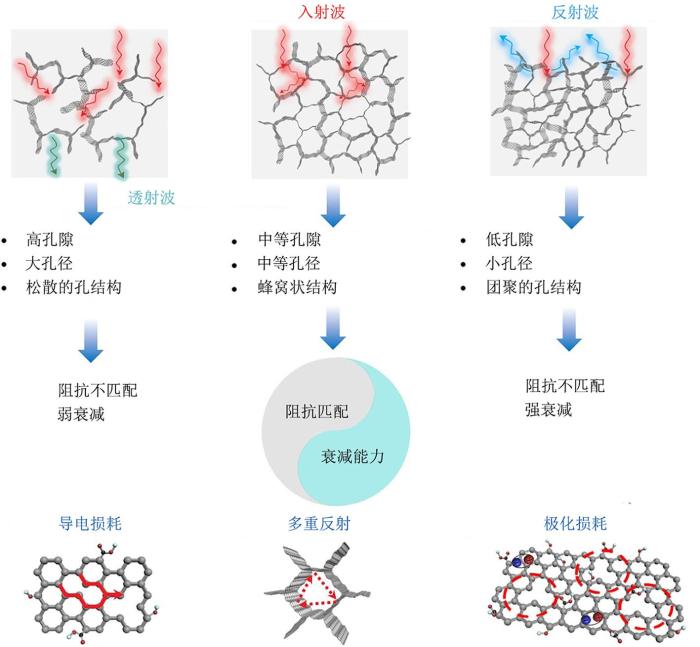
... 石墨烯不含有磁组分,对入射电磁波的损耗只能通过介电损耗实现.因此,调节阻抗匹配特性,使得更多入射电磁波进入石墨烯材料内部是增强石墨烯吸波性能的有效措施.电磁超材料能够通过微结构设计来实现阻抗匹配[51-53].与二维片层结构的石墨烯相比,通过冷冻干燥、水热自组装等方法,石墨烯能够形成海绵、气凝胶和泡沫等形貌的3D材料[54-56].由于多孔隙和3D空间构型的存在,这类具有特殊形貌的石墨烯具有更低的密度和较合适的阻抗匹配,能够增加多次反射和界面极化,进而增强介电损耗.Sun et al[57]通过冷冻干燥和化学气相还原制备了球形、立方体形、六棱柱形和平截头棱锥形的石墨烯海绵.得益于多孔结构增加了电磁波的多次反射,具有平截头棱锥形的石墨烯海绵实现了超宽频带的有效吸收(37.6 GHz).因此,具有这种特殊形貌的石墨烯海绵无疑会在宽带电磁防护领域有重要的发展前景.Huang et al[58]通过冻融组装法合成了蜂窝状石墨烯气凝胶.轻质(5.83 mg·cm-3)和多孔(94.9%)的结构使石墨烯气凝胶有着大量的内部孔隙,能够与自由空间形成较好的阻抗匹配,增加电磁波的透射.均匀微孔结构的3D多孔网络的形成,能够显著增强介电损耗的能力.此外,轻质与高孔隙率使其具有更高的比表面积和更多的边缘原子,也无疑会增强入射电磁波在其内部的多重散射,增强界面极化(图1).通过还原时间实现对气凝胶孔隙大小的调控,进而解释了气凝胶的孔结构与其微波吸收性能之间的关系,这为石墨烯气凝胶孔结构工程向超轻质电磁吸波材料的发展提供了新的途径.此外,优异的抗霜与隔热性质使其在特殊环境下有着良好的应用前景. ...
Perfect metamaterial absorber
0
2008
Flexible silver nanowire/carbon fiber felt metacomposites with weakly negative permittivity behavior
1
2020
... 石墨烯不含有磁组分,对入射电磁波的损耗只能通过介电损耗实现.因此,调节阻抗匹配特性,使得更多入射电磁波进入石墨烯材料内部是增强石墨烯吸波性能的有效措施.电磁超材料能够通过微结构设计来实现阻抗匹配[51-53].与二维片层结构的石墨烯相比,通过冷冻干燥、水热自组装等方法,石墨烯能够形成海绵、气凝胶和泡沫等形貌的3D材料[54-56].由于多孔隙和3D空间构型的存在,这类具有特殊形貌的石墨烯具有更低的密度和较合适的阻抗匹配,能够增加多次反射和界面极化,进而增强介电损耗.Sun et al[57]通过冷冻干燥和化学气相还原制备了球形、立方体形、六棱柱形和平截头棱锥形的石墨烯海绵.得益于多孔结构增加了电磁波的多次反射,具有平截头棱锥形的石墨烯海绵实现了超宽频带的有效吸收(37.6 GHz).因此,具有这种特殊形貌的石墨烯海绵无疑会在宽带电磁防护领域有重要的发展前景.Huang et al[58]通过冻融组装法合成了蜂窝状石墨烯气凝胶.轻质(5.83 mg·cm-3)和多孔(94.9%)的结构使石墨烯气凝胶有着大量的内部孔隙,能够与自由空间形成较好的阻抗匹配,增加电磁波的透射.均匀微孔结构的3D多孔网络的形成,能够显著增强介电损耗的能力.此外,轻质与高孔隙率使其具有更高的比表面积和更多的边缘原子,也无疑会增强入射电磁波在其内部的多重散射,增强界面极化(图1).通过还原时间实现对气凝胶孔隙大小的调控,进而解释了气凝胶的孔结构与其微波吸收性能之间的关系,这为石墨烯气凝胶孔结构工程向超轻质电磁吸波材料的发展提供了新的途径.此外,优异的抗霜与隔热性质使其在特殊环境下有着良好的应用前景. ...
Consecutively strong absorption from gigahertz to terahertz bands of a monolithic three?dimensional Fe3O4/graphene material
1
2019
... 石墨烯不含有磁组分,对入射电磁波的损耗只能通过介电损耗实现.因此,调节阻抗匹配特性,使得更多入射电磁波进入石墨烯材料内部是增强石墨烯吸波性能的有效措施.电磁超材料能够通过微结构设计来实现阻抗匹配[51-53].与二维片层结构的石墨烯相比,通过冷冻干燥、水热自组装等方法,石墨烯能够形成海绵、气凝胶和泡沫等形貌的3D材料[54-56].由于多孔隙和3D空间构型的存在,这类具有特殊形貌的石墨烯具有更低的密度和较合适的阻抗匹配,能够增加多次反射和界面极化,进而增强介电损耗.Sun et al[57]通过冷冻干燥和化学气相还原制备了球形、立方体形、六棱柱形和平截头棱锥形的石墨烯海绵.得益于多孔结构增加了电磁波的多次反射,具有平截头棱锥形的石墨烯海绵实现了超宽频带的有效吸收(37.6 GHz).因此,具有这种特殊形貌的石墨烯海绵无疑会在宽带电磁防护领域有重要的发展前景.Huang et al[58]通过冻融组装法合成了蜂窝状石墨烯气凝胶.轻质(5.83 mg·cm-3)和多孔(94.9%)的结构使石墨烯气凝胶有着大量的内部孔隙,能够与自由空间形成较好的阻抗匹配,增加电磁波的透射.均匀微孔结构的3D多孔网络的形成,能够显著增强介电损耗的能力.此外,轻质与高孔隙率使其具有更高的比表面积和更多的边缘原子,也无疑会增强入射电磁波在其内部的多重散射,增强界面极化(图1).通过还原时间实现对气凝胶孔隙大小的调控,进而解释了气凝胶的孔结构与其微波吸收性能之间的关系,这为石墨烯气凝胶孔结构工程向超轻质电磁吸波材料的发展提供了新的途径.此外,优异的抗霜与隔热性质使其在特殊环境下有着良好的应用前景. ...
Fabrication of ultralight three?dimensional graphene networks with strong electromagnetic wave absorption properties
0
2015
Composition and structure control of ultralight graphene foam for high?performance microwave absorption
1
2016
... 石墨烯不含有磁组分,对入射电磁波的损耗只能通过介电损耗实现.因此,调节阻抗匹配特性,使得更多入射电磁波进入石墨烯材料内部是增强石墨烯吸波性能的有效措施.电磁超材料能够通过微结构设计来实现阻抗匹配[51-53].与二维片层结构的石墨烯相比,通过冷冻干燥、水热自组装等方法,石墨烯能够形成海绵、气凝胶和泡沫等形貌的3D材料[54-56].由于多孔隙和3D空间构型的存在,这类具有特殊形貌的石墨烯具有更低的密度和较合适的阻抗匹配,能够增加多次反射和界面极化,进而增强介电损耗.Sun et al[57]通过冷冻干燥和化学气相还原制备了球形、立方体形、六棱柱形和平截头棱锥形的石墨烯海绵.得益于多孔结构增加了电磁波的多次反射,具有平截头棱锥形的石墨烯海绵实现了超宽频带的有效吸收(37.6 GHz).因此,具有这种特殊形貌的石墨烯海绵无疑会在宽带电磁防护领域有重要的发展前景.Huang et al[58]通过冻融组装法合成了蜂窝状石墨烯气凝胶.轻质(5.83 mg·cm-3)和多孔(94.9%)的结构使石墨烯气凝胶有着大量的内部孔隙,能够与自由空间形成较好的阻抗匹配,增加电磁波的透射.均匀微孔结构的3D多孔网络的形成,能够显著增强介电损耗的能力.此外,轻质与高孔隙率使其具有更高的比表面积和更多的边缘原子,也无疑会增强入射电磁波在其内部的多重散射,增强界面极化(图1).通过还原时间实现对气凝胶孔隙大小的调控,进而解释了气凝胶的孔结构与其微波吸收性能之间的关系,这为石墨烯气凝胶孔结构工程向超轻质电磁吸波材料的发展提供了新的途径.此外,优异的抗霜与隔热性质使其在特殊环境下有着良好的应用前景. ...
Achieving super broadband electromagnetic absorption by optimizing impedance match of RGO sponge metamaterials
1
2021
... 石墨烯不含有磁组分,对入射电磁波的损耗只能通过介电损耗实现.因此,调节阻抗匹配特性,使得更多入射电磁波进入石墨烯材料内部是增强石墨烯吸波性能的有效措施.电磁超材料能够通过微结构设计来实现阻抗匹配[51-53].与二维片层结构的石墨烯相比,通过冷冻干燥、水热自组装等方法,石墨烯能够形成海绵、气凝胶和泡沫等形貌的3D材料[54-56].由于多孔隙和3D空间构型的存在,这类具有特殊形貌的石墨烯具有更低的密度和较合适的阻抗匹配,能够增加多次反射和界面极化,进而增强介电损耗.Sun et al[57]通过冷冻干燥和化学气相还原制备了球形、立方体形、六棱柱形和平截头棱锥形的石墨烯海绵.得益于多孔结构增加了电磁波的多次反射,具有平截头棱锥形的石墨烯海绵实现了超宽频带的有效吸收(37.6 GHz).因此,具有这种特殊形貌的石墨烯海绵无疑会在宽带电磁防护领域有重要的发展前景.Huang et al[58]通过冻融组装法合成了蜂窝状石墨烯气凝胶.轻质(5.83 mg·cm-3)和多孔(94.9%)的结构使石墨烯气凝胶有着大量的内部孔隙,能够与自由空间形成较好的阻抗匹配,增加电磁波的透射.均匀微孔结构的3D多孔网络的形成,能够显著增强介电损耗的能力.此外,轻质与高孔隙率使其具有更高的比表面积和更多的边缘原子,也无疑会增强入射电磁波在其内部的多重散射,增强界面极化(图1).通过还原时间实现对气凝胶孔隙大小的调控,进而解释了气凝胶的孔结构与其微波吸收性能之间的关系,这为石墨烯气凝胶孔结构工程向超轻质电磁吸波材料的发展提供了新的途径.此外,优异的抗霜与隔热性质使其在特殊环境下有着良好的应用前景. ...
Design of cellular structure of graphene aerogels for electromagnetic wave absorption
3
... 石墨烯不含有磁组分,对入射电磁波的损耗只能通过介电损耗实现.因此,调节阻抗匹配特性,使得更多入射电磁波进入石墨烯材料内部是增强石墨烯吸波性能的有效措施.电磁超材料能够通过微结构设计来实现阻抗匹配[51-53].与二维片层结构的石墨烯相比,通过冷冻干燥、水热自组装等方法,石墨烯能够形成海绵、气凝胶和泡沫等形貌的3D材料[54-56].由于多孔隙和3D空间构型的存在,这类具有特殊形貌的石墨烯具有更低的密度和较合适的阻抗匹配,能够增加多次反射和界面极化,进而增强介电损耗.Sun et al[57]通过冷冻干燥和化学气相还原制备了球形、立方体形、六棱柱形和平截头棱锥形的石墨烯海绵.得益于多孔结构增加了电磁波的多次反射,具有平截头棱锥形的石墨烯海绵实现了超宽频带的有效吸收(37.6 GHz).因此,具有这种特殊形貌的石墨烯海绵无疑会在宽带电磁防护领域有重要的发展前景.Huang et al[58]通过冻融组装法合成了蜂窝状石墨烯气凝胶.轻质(5.83 mg·cm-3)和多孔(94.9%)的结构使石墨烯气凝胶有着大量的内部孔隙,能够与自由空间形成较好的阻抗匹配,增加电磁波的透射.均匀微孔结构的3D多孔网络的形成,能够显著增强介电损耗的能力.此外,轻质与高孔隙率使其具有更高的比表面积和更多的边缘原子,也无疑会增强入射电磁波在其内部的多重散射,增强界面极化(图1).通过还原时间实现对气凝胶孔隙大小的调控,进而解释了气凝胶的孔结构与其微波吸收性能之间的关系,这为石墨烯气凝胶孔结构工程向超轻质电磁吸波材料的发展提供了新的途径.此外,优异的抗霜与隔热性质使其在特殊环境下有着良好的应用前景. ...
... [
58]
Schematic illustration of the electromagnetic wave absorption mechanism of RGO aerogels based on pore structure engineering (after ref.[<xref ref-type="bibr" rid="R58">58</xref>])Fig.1![]()
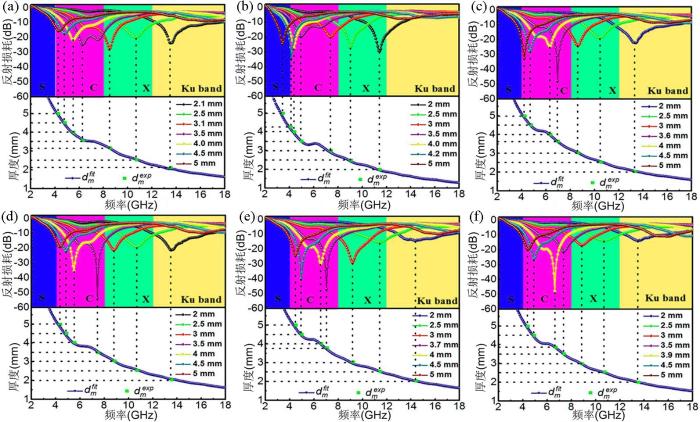
杂原子掺杂能够有效调节石墨烯的电子和化学性质[59-61].因此,除了调控石墨烯的微观结构,构建3D多孔网络体系之外,杂原子掺杂也被认为是一种调节石墨烯电学和化学性质的有效方法[62-63].由于杂原子的原子大小、键长和核外电子数都不同于碳原子,所以杂原子能够在碳原子附近引入大量的点缺陷,改善其表面电子结构和导电性,赋予石墨烯材料更多的活性位点.杂原子的引入不仅有效提高了石墨烯的电导率,增强了导电损耗,而且在掺杂过程中引入了大量结构缺陷,为石墨烯引入了极化弛豫损耗.其中,氮原子的尺寸、分子量与碳原子相近,有利于诱导产生无序的碳结构,提高石墨烯的导电性,加速电子运输.此外,由于π共轭效应,氮原子掺杂可以在石墨烯边缘和缺陷处引入0.95 μB的磁矩,使其富有一定的磁性[64-65],改善因高介电性能引起的阻抗失配问题.因此,氮原子掺杂的石墨烯在吸波领域有着良好的发展前景[66-68].Liu et al[69]通过水热自组装和冷冻干燥制备了氮掺杂石墨烯泡沫.与以往的石墨烯泡沫相比,他们制备的氮掺杂石墨烯泡沫在5 wt%的低填充和3.5 mm的厚度下,RL达到-53.9 dB,有效吸收带宽高达13 GHz(图2).此外,他们的研究也解释了不同的氮掺杂类型对损耗机制的作用原理.其中,吡啶氮和吡咯氮主要影响石墨烯的偶极弛豫损耗,而石墨氮则与传导损耗相关.这一研究为理解单组分氮掺杂石墨烯的吸波机理提供了新的基点,也推动了石墨烯吸波材料的合理构造和轻质化发展.随后,他们又研究了氮掺杂量对石墨烯吸波性能的影响[70].适量的氮掺杂有效地调节了衰减因子和阻抗匹配度的良好平衡,氮掺杂量为3.7 wt%的石墨烯的RL高达-55 dB,是未掺氮石墨烯的五倍.通过建立含氮量与石墨烯介电和吸波性能之间的匹配关系,将不同含氮量的石墨烯与衰减因子和阻抗匹配相结合,这一研究为石墨烯吸波材料的轻量化和便捷化提供新的途径. ...
... Schematic illustration of the electromagnetic wave absorption mechanism of RGO aerogels based on pore structure engineering (after ref.[
58])
Fig.1![]()
杂原子掺杂能够有效调节石墨烯的电子和化学性质[59-61].因此,除了调控石墨烯的微观结构,构建3D多孔网络体系之外,杂原子掺杂也被认为是一种调节石墨烯电学和化学性质的有效方法[62-63].由于杂原子的原子大小、键长和核外电子数都不同于碳原子,所以杂原子能够在碳原子附近引入大量的点缺陷,改善其表面电子结构和导电性,赋予石墨烯材料更多的活性位点.杂原子的引入不仅有效提高了石墨烯的电导率,增强了导电损耗,而且在掺杂过程中引入了大量结构缺陷,为石墨烯引入了极化弛豫损耗.其中,氮原子的尺寸、分子量与碳原子相近,有利于诱导产生无序的碳结构,提高石墨烯的导电性,加速电子运输.此外,由于π共轭效应,氮原子掺杂可以在石墨烯边缘和缺陷处引入0.95 μB的磁矩,使其富有一定的磁性[64-65],改善因高介电性能引起的阻抗失配问题.因此,氮原子掺杂的石墨烯在吸波领域有着良好的发展前景[66-68].Liu et al[69]通过水热自组装和冷冻干燥制备了氮掺杂石墨烯泡沫.与以往的石墨烯泡沫相比,他们制备的氮掺杂石墨烯泡沫在5 wt%的低填充和3.5 mm的厚度下,RL达到-53.9 dB,有效吸收带宽高达13 GHz(图2).此外,他们的研究也解释了不同的氮掺杂类型对损耗机制的作用原理.其中,吡啶氮和吡咯氮主要影响石墨烯的偶极弛豫损耗,而石墨氮则与传导损耗相关.这一研究为理解单组分氮掺杂石墨烯的吸波机理提供了新的基点,也推动了石墨烯吸波材料的合理构造和轻质化发展.随后,他们又研究了氮掺杂量对石墨烯吸波性能的影响[70].适量的氮掺杂有效地调节了衰减因子和阻抗匹配度的良好平衡,氮掺杂量为3.7 wt%的石墨烯的RL高达-55 dB,是未掺氮石墨烯的五倍.通过建立含氮量与石墨烯介电和吸波性能之间的匹配关系,将不同含氮量的石墨烯与衰减因子和阻抗匹配相结合,这一研究为石墨烯吸波材料的轻量化和便捷化提供新的途径. ...
Towards new graphene materials:Doped graphene sheets and nanoribbons
1
2012
... 杂原子掺杂能够有效调节石墨烯的电子和化学性质[59-61].因此,除了调控石墨烯的微观结构,构建3D多孔网络体系之外,杂原子掺杂也被认为是一种调节石墨烯电学和化学性质的有效方法[62-63].由于杂原子的原子大小、键长和核外电子数都不同于碳原子,所以杂原子能够在碳原子附近引入大量的点缺陷,改善其表面电子结构和导电性,赋予石墨烯材料更多的活性位点.杂原子的引入不仅有效提高了石墨烯的电导率,增强了导电损耗,而且在掺杂过程中引入了大量结构缺陷,为石墨烯引入了极化弛豫损耗.其中,氮原子的尺寸、分子量与碳原子相近,有利于诱导产生无序的碳结构,提高石墨烯的导电性,加速电子运输.此外,由于π共轭效应,氮原子掺杂可以在石墨烯边缘和缺陷处引入0.95 μB的磁矩,使其富有一定的磁性[64-65],改善因高介电性能引起的阻抗失配问题.因此,氮原子掺杂的石墨烯在吸波领域有着良好的发展前景[66-68].Liu et al[69]通过水热自组装和冷冻干燥制备了氮掺杂石墨烯泡沫.与以往的石墨烯泡沫相比,他们制备的氮掺杂石墨烯泡沫在5 wt%的低填充和3.5 mm的厚度下,RL达到-53.9 dB,有效吸收带宽高达13 GHz(图2).此外,他们的研究也解释了不同的氮掺杂类型对损耗机制的作用原理.其中,吡啶氮和吡咯氮主要影响石墨烯的偶极弛豫损耗,而石墨氮则与传导损耗相关.这一研究为理解单组分氮掺杂石墨烯的吸波机理提供了新的基点,也推动了石墨烯吸波材料的合理构造和轻质化发展.随后,他们又研究了氮掺杂量对石墨烯吸波性能的影响[70].适量的氮掺杂有效地调节了衰减因子和阻抗匹配度的良好平衡,氮掺杂量为3.7 wt%的石墨烯的RL高达-55 dB,是未掺氮石墨烯的五倍.通过建立含氮量与石墨烯介电和吸波性能之间的匹配关系,将不同含氮量的石墨烯与衰减因子和阻抗匹配相结合,这一研究为石墨烯吸波材料的轻量化和便捷化提供新的途径. ...
Controllable synthesis of doped graphene and its applications
0
2014
Role of doped nitrogen in graphene for flow?induced power generation
1
2018
... 杂原子掺杂能够有效调节石墨烯的电子和化学性质[59-61].因此,除了调控石墨烯的微观结构,构建3D多孔网络体系之外,杂原子掺杂也被认为是一种调节石墨烯电学和化学性质的有效方法[62-63].由于杂原子的原子大小、键长和核外电子数都不同于碳原子,所以杂原子能够在碳原子附近引入大量的点缺陷,改善其表面电子结构和导电性,赋予石墨烯材料更多的活性位点.杂原子的引入不仅有效提高了石墨烯的电导率,增强了导电损耗,而且在掺杂过程中引入了大量结构缺陷,为石墨烯引入了极化弛豫损耗.其中,氮原子的尺寸、分子量与碳原子相近,有利于诱导产生无序的碳结构,提高石墨烯的导电性,加速电子运输.此外,由于π共轭效应,氮原子掺杂可以在石墨烯边缘和缺陷处引入0.95 μB的磁矩,使其富有一定的磁性[64-65],改善因高介电性能引起的阻抗失配问题.因此,氮原子掺杂的石墨烯在吸波领域有着良好的发展前景[66-68].Liu et al[69]通过水热自组装和冷冻干燥制备了氮掺杂石墨烯泡沫.与以往的石墨烯泡沫相比,他们制备的氮掺杂石墨烯泡沫在5 wt%的低填充和3.5 mm的厚度下,RL达到-53.9 dB,有效吸收带宽高达13 GHz(图2).此外,他们的研究也解释了不同的氮掺杂类型对损耗机制的作用原理.其中,吡啶氮和吡咯氮主要影响石墨烯的偶极弛豫损耗,而石墨氮则与传导损耗相关.这一研究为理解单组分氮掺杂石墨烯的吸波机理提供了新的基点,也推动了石墨烯吸波材料的合理构造和轻质化发展.随后,他们又研究了氮掺杂量对石墨烯吸波性能的影响[70].适量的氮掺杂有效地调节了衰减因子和阻抗匹配度的良好平衡,氮掺杂量为3.7 wt%的石墨烯的RL高达-55 dB,是未掺氮石墨烯的五倍.通过建立含氮量与石墨烯介电和吸波性能之间的匹配关系,将不同含氮量的石墨烯与衰减因子和阻抗匹配相结合,这一研究为石墨烯吸波材料的轻量化和便捷化提供新的途径. ...
Solvothermal synthesis of nitrogen?doped graphene decorated by super?paramagnetic Fe3O4 nanoparticles and their applications as enhanced synergistic microwave absorbers
1
2017
... 杂原子掺杂能够有效调节石墨烯的电子和化学性质[59-61].因此,除了调控石墨烯的微观结构,构建3D多孔网络体系之外,杂原子掺杂也被认为是一种调节石墨烯电学和化学性质的有效方法[62-63].由于杂原子的原子大小、键长和核外电子数都不同于碳原子,所以杂原子能够在碳原子附近引入大量的点缺陷,改善其表面电子结构和导电性,赋予石墨烯材料更多的活性位点.杂原子的引入不仅有效提高了石墨烯的电导率,增强了导电损耗,而且在掺杂过程中引入了大量结构缺陷,为石墨烯引入了极化弛豫损耗.其中,氮原子的尺寸、分子量与碳原子相近,有利于诱导产生无序的碳结构,提高石墨烯的导电性,加速电子运输.此外,由于π共轭效应,氮原子掺杂可以在石墨烯边缘和缺陷处引入0.95 μB的磁矩,使其富有一定的磁性[64-65],改善因高介电性能引起的阻抗失配问题.因此,氮原子掺杂的石墨烯在吸波领域有着良好的发展前景[66-68].Liu et al[69]通过水热自组装和冷冻干燥制备了氮掺杂石墨烯泡沫.与以往的石墨烯泡沫相比,他们制备的氮掺杂石墨烯泡沫在5 wt%的低填充和3.5 mm的厚度下,RL达到-53.9 dB,有效吸收带宽高达13 GHz(图2).此外,他们的研究也解释了不同的氮掺杂类型对损耗机制的作用原理.其中,吡啶氮和吡咯氮主要影响石墨烯的偶极弛豫损耗,而石墨氮则与传导损耗相关.这一研究为理解单组分氮掺杂石墨烯的吸波机理提供了新的基点,也推动了石墨烯吸波材料的合理构造和轻质化发展.随后,他们又研究了氮掺杂量对石墨烯吸波性能的影响[70].适量的氮掺杂有效地调节了衰减因子和阻抗匹配度的良好平衡,氮掺杂量为3.7 wt%的石墨烯的RL高达-55 dB,是未掺氮石墨烯的五倍.通过建立含氮量与石墨烯介电和吸波性能之间的匹配关系,将不同含氮量的石墨烯与衰减因子和阻抗匹配相结合,这一研究为石墨烯吸波材料的轻量化和便捷化提供新的途径. ...
Facile design of three?dimensional nitrogen?doped reduced graphene oxide/multiwalled carbon nanotube composite foams as lightweight and highly efficient microwave absorbers
1
2020
... 杂原子掺杂能够有效调节石墨烯的电子和化学性质[59-61].因此,除了调控石墨烯的微观结构,构建3D多孔网络体系之外,杂原子掺杂也被认为是一种调节石墨烯电学和化学性质的有效方法[62-63].由于杂原子的原子大小、键长和核外电子数都不同于碳原子,所以杂原子能够在碳原子附近引入大量的点缺陷,改善其表面电子结构和导电性,赋予石墨烯材料更多的活性位点.杂原子的引入不仅有效提高了石墨烯的电导率,增强了导电损耗,而且在掺杂过程中引入了大量结构缺陷,为石墨烯引入了极化弛豫损耗.其中,氮原子的尺寸、分子量与碳原子相近,有利于诱导产生无序的碳结构,提高石墨烯的导电性,加速电子运输.此外,由于π共轭效应,氮原子掺杂可以在石墨烯边缘和缺陷处引入0.95 μB的磁矩,使其富有一定的磁性[64-65],改善因高介电性能引起的阻抗失配问题.因此,氮原子掺杂的石墨烯在吸波领域有着良好的发展前景[66-68].Liu et al[69]通过水热自组装和冷冻干燥制备了氮掺杂石墨烯泡沫.与以往的石墨烯泡沫相比,他们制备的氮掺杂石墨烯泡沫在5 wt%的低填充和3.5 mm的厚度下,RL达到-53.9 dB,有效吸收带宽高达13 GHz(图2).此外,他们的研究也解释了不同的氮掺杂类型对损耗机制的作用原理.其中,吡啶氮和吡咯氮主要影响石墨烯的偶极弛豫损耗,而石墨氮则与传导损耗相关.这一研究为理解单组分氮掺杂石墨烯的吸波机理提供了新的基点,也推动了石墨烯吸波材料的合理构造和轻质化发展.随后,他们又研究了氮掺杂量对石墨烯吸波性能的影响[70].适量的氮掺杂有效地调节了衰减因子和阻抗匹配度的良好平衡,氮掺杂量为3.7 wt%的石墨烯的RL高达-55 dB,是未掺氮石墨烯的五倍.通过建立含氮量与石墨烯介电和吸波性能之间的匹配关系,将不同含氮量的石墨烯与衰减因子和阻抗匹配相结合,这一研究为石墨烯吸波材料的轻量化和便捷化提供新的途径. ...
Nitrogen?doped graphene nanosheets as anode materials for lithium ion batteries:A first?principles study
1
2012
... 杂原子掺杂能够有效调节石墨烯的电子和化学性质[59-61].因此,除了调控石墨烯的微观结构,构建3D多孔网络体系之外,杂原子掺杂也被认为是一种调节石墨烯电学和化学性质的有效方法[62-63].由于杂原子的原子大小、键长和核外电子数都不同于碳原子,所以杂原子能够在碳原子附近引入大量的点缺陷,改善其表面电子结构和导电性,赋予石墨烯材料更多的活性位点.杂原子的引入不仅有效提高了石墨烯的电导率,增强了导电损耗,而且在掺杂过程中引入了大量结构缺陷,为石墨烯引入了极化弛豫损耗.其中,氮原子的尺寸、分子量与碳原子相近,有利于诱导产生无序的碳结构,提高石墨烯的导电性,加速电子运输.此外,由于π共轭效应,氮原子掺杂可以在石墨烯边缘和缺陷处引入0.95 μB的磁矩,使其富有一定的磁性[64-65],改善因高介电性能引起的阻抗失配问题.因此,氮原子掺杂的石墨烯在吸波领域有着良好的发展前景[66-68].Liu et al[69]通过水热自组装和冷冻干燥制备了氮掺杂石墨烯泡沫.与以往的石墨烯泡沫相比,他们制备的氮掺杂石墨烯泡沫在5 wt%的低填充和3.5 mm的厚度下,RL达到-53.9 dB,有效吸收带宽高达13 GHz(图2).此外,他们的研究也解释了不同的氮掺杂类型对损耗机制的作用原理.其中,吡啶氮和吡咯氮主要影响石墨烯的偶极弛豫损耗,而石墨氮则与传导损耗相关.这一研究为理解单组分氮掺杂石墨烯的吸波机理提供了新的基点,也推动了石墨烯吸波材料的合理构造和轻质化发展.随后,他们又研究了氮掺杂量对石墨烯吸波性能的影响[70].适量的氮掺杂有效地调节了衰减因子和阻抗匹配度的良好平衡,氮掺杂量为3.7 wt%的石墨烯的RL高达-55 dB,是未掺氮石墨烯的五倍.通过建立含氮量与石墨烯介电和吸波性能之间的匹配关系,将不同含氮量的石墨烯与衰减因子和阻抗匹配相结合,这一研究为石墨烯吸波材料的轻量化和便捷化提供新的途径. ...
Realization of ferromagnetic graphene oxide with high magnetization by doping graphene oxide with nitrogen
1
... 杂原子掺杂能够有效调节石墨烯的电子和化学性质[59-61].因此,除了调控石墨烯的微观结构,构建3D多孔网络体系之外,杂原子掺杂也被认为是一种调节石墨烯电学和化学性质的有效方法[62-63].由于杂原子的原子大小、键长和核外电子数都不同于碳原子,所以杂原子能够在碳原子附近引入大量的点缺陷,改善其表面电子结构和导电性,赋予石墨烯材料更多的活性位点.杂原子的引入不仅有效提高了石墨烯的电导率,增强了导电损耗,而且在掺杂过程中引入了大量结构缺陷,为石墨烯引入了极化弛豫损耗.其中,氮原子的尺寸、分子量与碳原子相近,有利于诱导产生无序的碳结构,提高石墨烯的导电性,加速电子运输.此外,由于π共轭效应,氮原子掺杂可以在石墨烯边缘和缺陷处引入0.95 μB的磁矩,使其富有一定的磁性[64-65],改善因高介电性能引起的阻抗失配问题.因此,氮原子掺杂的石墨烯在吸波领域有着良好的发展前景[66-68].Liu et al[69]通过水热自组装和冷冻干燥制备了氮掺杂石墨烯泡沫.与以往的石墨烯泡沫相比,他们制备的氮掺杂石墨烯泡沫在5 wt%的低填充和3.5 mm的厚度下,RL达到-53.9 dB,有效吸收带宽高达13 GHz(图2).此外,他们的研究也解释了不同的氮掺杂类型对损耗机制的作用原理.其中,吡啶氮和吡咯氮主要影响石墨烯的偶极弛豫损耗,而石墨氮则与传导损耗相关.这一研究为理解单组分氮掺杂石墨烯的吸波机理提供了新的基点,也推动了石墨烯吸波材料的合理构造和轻质化发展.随后,他们又研究了氮掺杂量对石墨烯吸波性能的影响[70].适量的氮掺杂有效地调节了衰减因子和阻抗匹配度的良好平衡,氮掺杂量为3.7 wt%的石墨烯的RL高达-55 dB,是未掺氮石墨烯的五倍.通过建立含氮量与石墨烯介电和吸波性能之间的匹配关系,将不同含氮量的石墨烯与衰减因子和阻抗匹配相结合,这一研究为石墨烯吸波材料的轻量化和便捷化提供新的途径. ...
Magnetic graphene for microwave absorbing application:Towards the lightest graphene?based absorber
1
2017
... 杂原子掺杂能够有效调节石墨烯的电子和化学性质[59-61].因此,除了调控石墨烯的微观结构,构建3D多孔网络体系之外,杂原子掺杂也被认为是一种调节石墨烯电学和化学性质的有效方法[62-63].由于杂原子的原子大小、键长和核外电子数都不同于碳原子,所以杂原子能够在碳原子附近引入大量的点缺陷,改善其表面电子结构和导电性,赋予石墨烯材料更多的活性位点.杂原子的引入不仅有效提高了石墨烯的电导率,增强了导电损耗,而且在掺杂过程中引入了大量结构缺陷,为石墨烯引入了极化弛豫损耗.其中,氮原子的尺寸、分子量与碳原子相近,有利于诱导产生无序的碳结构,提高石墨烯的导电性,加速电子运输.此外,由于π共轭效应,氮原子掺杂可以在石墨烯边缘和缺陷处引入0.95 μB的磁矩,使其富有一定的磁性[64-65],改善因高介电性能引起的阻抗失配问题.因此,氮原子掺杂的石墨烯在吸波领域有着良好的发展前景[66-68].Liu et al[69]通过水热自组装和冷冻干燥制备了氮掺杂石墨烯泡沫.与以往的石墨烯泡沫相比,他们制备的氮掺杂石墨烯泡沫在5 wt%的低填充和3.5 mm的厚度下,RL达到-53.9 dB,有效吸收带宽高达13 GHz(图2).此外,他们的研究也解释了不同的氮掺杂类型对损耗机制的作用原理.其中,吡啶氮和吡咯氮主要影响石墨烯的偶极弛豫损耗,而石墨氮则与传导损耗相关.这一研究为理解单组分氮掺杂石墨烯的吸波机理提供了新的基点,也推动了石墨烯吸波材料的合理构造和轻质化发展.随后,他们又研究了氮掺杂量对石墨烯吸波性能的影响[70].适量的氮掺杂有效地调节了衰减因子和阻抗匹配度的良好平衡,氮掺杂量为3.7 wt%的石墨烯的RL高达-55 dB,是未掺氮石墨烯的五倍.通过建立含氮量与石墨烯介电和吸波性能之间的匹配关系,将不同含氮量的石墨烯与衰减因子和阻抗匹配相结合,这一研究为石墨烯吸波材料的轻量化和便捷化提供新的途径. ...
Facile synthesis of three?dimensional lightweight nitrogen?doped graphene aerogel with excellent electromagnetic wave absorption properties
0
2017
The role of graphene oxide precursor morphology in magnetic and microwave absorption properties of nitrogen?doped graphene
3
... 杂原子掺杂能够有效调节石墨烯的电子和化学性质[59-61].因此,除了调控石墨烯的微观结构,构建3D多孔网络体系之外,杂原子掺杂也被认为是一种调节石墨烯电学和化学性质的有效方法[62-63].由于杂原子的原子大小、键长和核外电子数都不同于碳原子,所以杂原子能够在碳原子附近引入大量的点缺陷,改善其表面电子结构和导电性,赋予石墨烯材料更多的活性位点.杂原子的引入不仅有效提高了石墨烯的电导率,增强了导电损耗,而且在掺杂过程中引入了大量结构缺陷,为石墨烯引入了极化弛豫损耗.其中,氮原子的尺寸、分子量与碳原子相近,有利于诱导产生无序的碳结构,提高石墨烯的导电性,加速电子运输.此外,由于π共轭效应,氮原子掺杂可以在石墨烯边缘和缺陷处引入0.95 μB的磁矩,使其富有一定的磁性[64-65],改善因高介电性能引起的阻抗失配问题.因此,氮原子掺杂的石墨烯在吸波领域有着良好的发展前景[66-68].Liu et al[69]通过水热自组装和冷冻干燥制备了氮掺杂石墨烯泡沫.与以往的石墨烯泡沫相比,他们制备的氮掺杂石墨烯泡沫在5 wt%的低填充和3.5 mm的厚度下,RL达到-53.9 dB,有效吸收带宽高达13 GHz(图2).此外,他们的研究也解释了不同的氮掺杂类型对损耗机制的作用原理.其中,吡啶氮和吡咯氮主要影响石墨烯的偶极弛豫损耗,而石墨氮则与传导损耗相关.这一研究为理解单组分氮掺杂石墨烯的吸波机理提供了新的基点,也推动了石墨烯吸波材料的合理构造和轻质化发展.随后,他们又研究了氮掺杂量对石墨烯吸波性能的影响[70].适量的氮掺杂有效地调节了衰减因子和阻抗匹配度的良好平衡,氮掺杂量为3.7 wt%的石墨烯的RL高达-55 dB,是未掺氮石墨烯的五倍.通过建立含氮量与石墨烯介电和吸波性能之间的匹配关系,将不同含氮量的石墨烯与衰减因子和阻抗匹配相结合,这一研究为石墨烯吸波材料的轻量化和便捷化提供新的途径. ...
... [
68]
Frequency dependence of <i>RL</i> curves and the calculated matching thickness versus peak frequency of GF<sub>800</sub> (a),NGF<sub>700</sub>⁃0.6 (b),NGF<sub>800</sub>⁃0.3 (c),NGF<sub>800</sub>⁃0.6 (d),NGF<sub>800</sub>⁃0.9 (e),and NGF<sub>800</sub>⁃1.2 (f) (after ref.[<xref ref-type="bibr" rid="R68">68</xref>])Fig.2![]()
除了氮原子,硫原子也是一种常用的碳基材料杂原子掺杂剂,并且在低温磁性材料[71-72]、电磁屏蔽材料[73]和吸波材料[74-75]等领域有广泛的应用.如Tan et al[76]制备的S⁃GS材料在1.2 mm厚度下的RL达到-52.3 dB.这为拓宽杂原子掺杂石墨烯吸波材料的发展提供了新的途径.Quan et al[77]合成了氮硫双掺杂石墨烯吸波材料.其中,第一步掺杂决定了材料的形貌、尺寸和吸波性能,而第二步掺杂则是对掺杂位置的进一步调整.这有助于理解不同掺杂原子之间的相互关系,为实现可控的多元素掺杂提供了新的策略. ...
... ⁃1.2 (f) (after ref.[
68])
Fig.2![]()
除了氮原子,硫原子也是一种常用的碳基材料杂原子掺杂剂,并且在低温磁性材料[71-72]、电磁屏蔽材料[73]和吸波材料[74-75]等领域有广泛的应用.如Tan et al[76]制备的S⁃GS材料在1.2 mm厚度下的RL达到-52.3 dB.这为拓宽杂原子掺杂石墨烯吸波材料的发展提供了新的途径.Quan et al[77]合成了氮硫双掺杂石墨烯吸波材料.其中,第一步掺杂决定了材料的形貌、尺寸和吸波性能,而第二步掺杂则是对掺杂位置的进一步调整.这有助于理解不同掺杂原子之间的相互关系,为实现可控的多元素掺杂提供了新的策略. ...
Synthesis of lightweight N?doped graphene foams with open reticular structure for high?efficiency electromagnetic wave absorption
1
2019
... 杂原子掺杂能够有效调节石墨烯的电子和化学性质[59-61].因此,除了调控石墨烯的微观结构,构建3D多孔网络体系之外,杂原子掺杂也被认为是一种调节石墨烯电学和化学性质的有效方法[62-63].由于杂原子的原子大小、键长和核外电子数都不同于碳原子,所以杂原子能够在碳原子附近引入大量的点缺陷,改善其表面电子结构和导电性,赋予石墨烯材料更多的活性位点.杂原子的引入不仅有效提高了石墨烯的电导率,增强了导电损耗,而且在掺杂过程中引入了大量结构缺陷,为石墨烯引入了极化弛豫损耗.其中,氮原子的尺寸、分子量与碳原子相近,有利于诱导产生无序的碳结构,提高石墨烯的导电性,加速电子运输.此外,由于π共轭效应,氮原子掺杂可以在石墨烯边缘和缺陷处引入0.95 μB的磁矩,使其富有一定的磁性[64-65],改善因高介电性能引起的阻抗失配问题.因此,氮原子掺杂的石墨烯在吸波领域有着良好的发展前景[66-68].Liu et al[69]通过水热自组装和冷冻干燥制备了氮掺杂石墨烯泡沫.与以往的石墨烯泡沫相比,他们制备的氮掺杂石墨烯泡沫在5 wt%的低填充和3.5 mm的厚度下,RL达到-53.9 dB,有效吸收带宽高达13 GHz(图2).此外,他们的研究也解释了不同的氮掺杂类型对损耗机制的作用原理.其中,吡啶氮和吡咯氮主要影响石墨烯的偶极弛豫损耗,而石墨氮则与传导损耗相关.这一研究为理解单组分氮掺杂石墨烯的吸波机理提供了新的基点,也推动了石墨烯吸波材料的合理构造和轻质化发展.随后,他们又研究了氮掺杂量对石墨烯吸波性能的影响[70].适量的氮掺杂有效地调节了衰减因子和阻抗匹配度的良好平衡,氮掺杂量为3.7 wt%的石墨烯的RL高达-55 dB,是未掺氮石墨烯的五倍.通过建立含氮量与石墨烯介电和吸波性能之间的匹配关系,将不同含氮量的石墨烯与衰减因子和阻抗匹配相结合,这一研究为石墨烯吸波材料的轻量化和便捷化提供新的途径. ...
Correlating the gradient nitrogen doping and electromagnetic wave absorption of graphene at gigahertz
1
... 杂原子掺杂能够有效调节石墨烯的电子和化学性质[59-61].因此,除了调控石墨烯的微观结构,构建3D多孔网络体系之外,杂原子掺杂也被认为是一种调节石墨烯电学和化学性质的有效方法[62-63].由于杂原子的原子大小、键长和核外电子数都不同于碳原子,所以杂原子能够在碳原子附近引入大量的点缺陷,改善其表面电子结构和导电性,赋予石墨烯材料更多的活性位点.杂原子的引入不仅有效提高了石墨烯的电导率,增强了导电损耗,而且在掺杂过程中引入了大量结构缺陷,为石墨烯引入了极化弛豫损耗.其中,氮原子的尺寸、分子量与碳原子相近,有利于诱导产生无序的碳结构,提高石墨烯的导电性,加速电子运输.此外,由于π共轭效应,氮原子掺杂可以在石墨烯边缘和缺陷处引入0.95 μB的磁矩,使其富有一定的磁性[64-65],改善因高介电性能引起的阻抗失配问题.因此,氮原子掺杂的石墨烯在吸波领域有着良好的发展前景[66-68].Liu et al[69]通过水热自组装和冷冻干燥制备了氮掺杂石墨烯泡沫.与以往的石墨烯泡沫相比,他们制备的氮掺杂石墨烯泡沫在5 wt%的低填充和3.5 mm的厚度下,RL达到-53.9 dB,有效吸收带宽高达13 GHz(图2).此外,他们的研究也解释了不同的氮掺杂类型对损耗机制的作用原理.其中,吡啶氮和吡咯氮主要影响石墨烯的偶极弛豫损耗,而石墨氮则与传导损耗相关.这一研究为理解单组分氮掺杂石墨烯的吸波机理提供了新的基点,也推动了石墨烯吸波材料的合理构造和轻质化发展.随后,他们又研究了氮掺杂量对石墨烯吸波性能的影响[70].适量的氮掺杂有效地调节了衰减因子和阻抗匹配度的良好平衡,氮掺杂量为3.7 wt%的石墨烯的RL高达-55 dB,是未掺氮石墨烯的五倍.通过建立含氮量与石墨烯介电和吸波性能之间的匹配关系,将不同含氮量的石墨烯与衰减因子和阻抗匹配相结合,这一研究为石墨烯吸波材料的轻量化和便捷化提供新的途径. ...
Sulfur doping induces strong ferromagnetic ordering in graphene:Effect of concentration and substitution mechanism
1
2016
... 除了氮原子,硫原子也是一种常用的碳基材料杂原子掺杂剂,并且在低温磁性材料[71-72]、电磁屏蔽材料[73]和吸波材料[74-75]等领域有广泛的应用.如Tan et al[76]制备的S⁃GS材料在1.2 mm厚度下的RL达到-52.3 dB.这为拓宽杂原子掺杂石墨烯吸波材料的发展提供了新的途径.Quan et al[77]合成了氮硫双掺杂石墨烯吸波材料.其中,第一步掺杂决定了材料的形貌、尺寸和吸波性能,而第二步掺杂则是对掺杂位置的进一步调整.这有助于理解不同掺杂原子之间的相互关系,为实现可控的多元素掺杂提供了新的策略. ...
Magnetic effects in sulfur?decorated graphene
1
... 除了氮原子,硫原子也是一种常用的碳基材料杂原子掺杂剂,并且在低温磁性材料[71-72]、电磁屏蔽材料[73]和吸波材料[74-75]等领域有广泛的应用.如Tan et al[76]制备的S⁃GS材料在1.2 mm厚度下的RL达到-52.3 dB.这为拓宽杂原子掺杂石墨烯吸波材料的发展提供了新的途径.Quan et al[77]合成了氮硫双掺杂石墨烯吸波材料.其中,第一步掺杂决定了材料的形貌、尺寸和吸波性能,而第二步掺杂则是对掺杂位置的进一步调整.这有助于理解不同掺杂原子之间的相互关系,为实现可控的多元素掺杂提供了新的策略. ...
Biomass?derived thermally annealed interconnected sulfur?doped graphene as a shield against electromagnetic?interference
1
2016
... 除了氮原子,硫原子也是一种常用的碳基材料杂原子掺杂剂,并且在低温磁性材料[71-72]、电磁屏蔽材料[73]和吸波材料[74-75]等领域有广泛的应用.如Tan et al[76]制备的S⁃GS材料在1.2 mm厚度下的RL达到-52.3 dB.这为拓宽杂原子掺杂石墨烯吸波材料的发展提供了新的途径.Quan et al[77]合成了氮硫双掺杂石墨烯吸波材料.其中,第一步掺杂决定了材料的形貌、尺寸和吸波性能,而第二步掺杂则是对掺杂位置的进一步调整.这有助于理解不同掺杂原子之间的相互关系,为实现可控的多元素掺杂提供了新的策略. ...
Doping strategy to boost the electromagnetic wave attenuation ability of hollow carbon spheres at elevated temperatures
1
2017
... 除了氮原子,硫原子也是一种常用的碳基材料杂原子掺杂剂,并且在低温磁性材料[71-72]、电磁屏蔽材料[73]和吸波材料[74-75]等领域有广泛的应用.如Tan et al[76]制备的S⁃GS材料在1.2 mm厚度下的RL达到-52.3 dB.这为拓宽杂原子掺杂石墨烯吸波材料的发展提供了新的途径.Quan et al[77]合成了氮硫双掺杂石墨烯吸波材料.其中,第一步掺杂决定了材料的形貌、尺寸和吸波性能,而第二步掺杂则是对掺杂位置的进一步调整.这有助于理解不同掺杂原子之间的相互关系,为实现可控的多元素掺杂提供了新的策略. ...
Enhanced microwave absorption performance of sulfur?doped hollow carbon microspheres with mesoporous shell as a broadband absorber
1
2020
... 除了氮原子,硫原子也是一种常用的碳基材料杂原子掺杂剂,并且在低温磁性材料[71-72]、电磁屏蔽材料[73]和吸波材料[74-75]等领域有广泛的应用.如Tan et al[76]制备的S⁃GS材料在1.2 mm厚度下的RL达到-52.3 dB.这为拓宽杂原子掺杂石墨烯吸波材料的发展提供了新的途径.Quan et al[77]合成了氮硫双掺杂石墨烯吸波材料.其中,第一步掺杂决定了材料的形貌、尺寸和吸波性能,而第二步掺杂则是对掺杂位置的进一步调整.这有助于理解不同掺杂原子之间的相互关系,为实现可控的多元素掺杂提供了新的策略. ...
Lightweight excellent microwave absorption properties based on sulfur doped graphene
1
2020
... 除了氮原子,硫原子也是一种常用的碳基材料杂原子掺杂剂,并且在低温磁性材料[71-72]、电磁屏蔽材料[73]和吸波材料[74-75]等领域有广泛的应用.如Tan et al[76]制备的S⁃GS材料在1.2 mm厚度下的RL达到-52.3 dB.这为拓宽杂原子掺杂石墨烯吸波材料的发展提供了新的途径.Quan et al[77]合成了氮硫双掺杂石墨烯吸波材料.其中,第一步掺杂决定了材料的形貌、尺寸和吸波性能,而第二步掺杂则是对掺杂位置的进一步调整.这有助于理解不同掺杂原子之间的相互关系,为实现可控的多元素掺杂提供了新的策略. ...
Sequencing dual dopants for an electromagnetic tunable graphene
1
... 除了氮原子,硫原子也是一种常用的碳基材料杂原子掺杂剂,并且在低温磁性材料[71-72]、电磁屏蔽材料[73]和吸波材料[74-75]等领域有广泛的应用.如Tan et al[76]制备的S⁃GS材料在1.2 mm厚度下的RL达到-52.3 dB.这为拓宽杂原子掺杂石墨烯吸波材料的发展提供了新的途径.Quan et al[77]合成了氮硫双掺杂石墨烯吸波材料.其中,第一步掺杂决定了材料的形貌、尺寸和吸波性能,而第二步掺杂则是对掺杂位置的进一步调整.这有助于理解不同掺杂原子之间的相互关系,为实现可控的多元素掺杂提供了新的策略. ...
A novel hierarchically porous magnetic carbon derived from biomass for strong lightweight microwave absorption
1
2019
... 界面阻抗匹配和电磁波损耗能力决定了吸波的吸波性能.虽然对石墨烯进行杂原子掺杂、结构和形貌调整,能够改善石墨烯材料的阻抗匹配,但是磁导率过小、阻抗难匹配和损耗机制单一等问题仍然是石墨烯材料继续发展的一大难题.根据电磁吸波理论,入射电磁波能够以电导、极化弛豫和磁损耗等多种方式被衰减.因此,理想的吸波材料应具有多种的电磁损耗机制[78-79].为了获得更优异的石墨烯吸波材料,研究者们对优化石墨烯基复合材料的吸波能力进行了大量研究.合理地引入其他组分,如碳纳米管、磁性金属、铁氧体和聚合物,是一种改善石墨烯基材料吸波性能的有效方法. ...
Synthesis and characterization of MoS2/Fe@Fe3O4 nanocomposites exhibiting enhanced microwave absorption performance at normal and oblique incidences
1
2019
... 界面阻抗匹配和电磁波损耗能力决定了吸波的吸波性能.虽然对石墨烯进行杂原子掺杂、结构和形貌调整,能够改善石墨烯材料的阻抗匹配,但是磁导率过小、阻抗难匹配和损耗机制单一等问题仍然是石墨烯材料继续发展的一大难题.根据电磁吸波理论,入射电磁波能够以电导、极化弛豫和磁损耗等多种方式被衰减.因此,理想的吸波材料应具有多种的电磁损耗机制[78-79].为了获得更优异的石墨烯吸波材料,研究者们对优化石墨烯基复合材料的吸波能力进行了大量研究.合理地引入其他组分,如碳纳米管、磁性金属、铁氧体和聚合物,是一种改善石墨烯基材料吸波性能的有效方法. ...
Processing of flexible plastic packaging waste into pyrolysis oil and multi?walled carbon nanotubes for electrocatalytic oxygen reduction
1
... 一维碳纳米管有着空心管状结构、大纵横比、优异的电学和力学,在电磁吸波领域有良好的发展前景[80-82],但是,高导电率引起的阻抗失配特性限制了其发展.采用合理的微结构设计,制备石墨烯/碳纳米管复合材料,能够有效提升复合材料的吸波性能.将一维的碳纳米管与二维的石墨烯结合,制备三维纳米碳材料,能够有效抑制石墨烯和碳纳米管的堆叠,从而实现对电磁波的良好吸收.石墨烯/碳纳米管复合材料的设计与构造有着广泛的研究. ...
Interface modulating CNTs@PANi hybrids by controlled unzipping of the walls of CNTs to achieve tunable high?performance microwave absorption
0
2019
In situ?derived carbon nanotube?decorated nitrogen?doped carbon?coated nickel hybrids from MOF/melamine for efficient electromagnetic wave absorption
1
2021
... 一维碳纳米管有着空心管状结构、大纵横比、优异的电学和力学,在电磁吸波领域有良好的发展前景[80-82],但是,高导电率引起的阻抗失配特性限制了其发展.采用合理的微结构设计,制备石墨烯/碳纳米管复合材料,能够有效提升复合材料的吸波性能.将一维的碳纳米管与二维的石墨烯结合,制备三维纳米碳材料,能够有效抑制石墨烯和碳纳米管的堆叠,从而实现对电磁波的良好吸收.石墨烯/碳纳米管复合材料的设计与构造有着广泛的研究. ...
Multi?scale structural nitrogen?doped rGO@CNTs composites with ultra?low loading towards microwave absorption
4
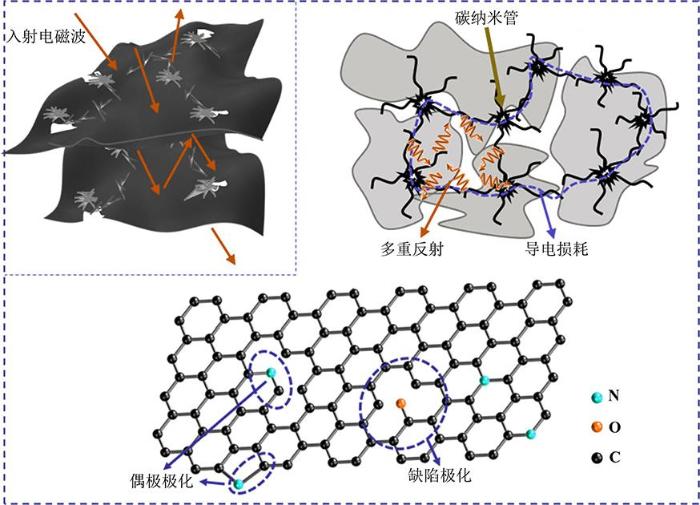
... Qian et al[83]通过化学掺杂和多组分复合制备了氮掺杂的还原石墨烯@碳纳米管(N⁃rGO@CNTs)复合材料并研究了碳纳米管含量对复合材料吸波性能的影响.其中,氮原子引入的缺陷与杂原子键有助于碳纳米管在石墨烯上的锚定.实验结果表明,随着碳纳米管和还原氧化石墨烯的质量比由0增加至0.3,褶皱的氮掺杂还原氧化石墨烯与不同取向的碳纳米管相互交错,逐渐形成完善的三维导电网络体系,从而显著提高了材料内部的电子传输能力和传导损耗.巢状的碳纳米管团簇、丰富的褶皱层和穿管也有利于电磁波的多次散射(图3)[83].2 wt%的低填充下,厚度为2.6 mm的N⁃rGO@CNTs复合材料的最小反射损耗为-49.4 dB,有效带宽为7.1 GHz.这为构造多尺度结构复合材料,获得可调谐的强吸波材料提供了新的策略. ...
... [83].2 wt%的低填充下,厚度为2.6 mm的N⁃rGO@CNTs复合材料的最小反射损耗为-49.4 dB,有效带宽为7.1 GHz.这为构造多尺度结构复合材料,获得可调谐的强吸波材料提供了新的策略. ...
... [
83]
Schematic diagram of the EMA absorbing mechanisms of N⁃rGO@CNTs composites (after ref.[<xref ref-type="bibr" rid="R83">83</xref>])Fig.3![]()
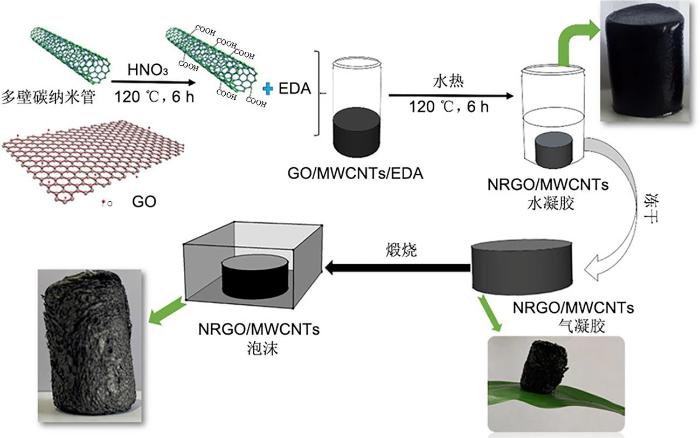
Shu et al[84]通过水热自组装、高温煅烧制备了氮掺杂还原氧化石墨烯/多壁碳纳米管复合泡沫,并研究了氮掺杂、煅烧温度和配比对复合泡沫吸波性能的影响(图4).三维网络结构和构造与氮掺杂增强的传导损耗和极化弛豫之间的协同作用,使复合泡沫有着优异的微波吸收性能.8 wt%填料下,厚度为1.5 mm的复合泡沫的最小反射损耗为-69.6 dB,有效带宽为4.3 GHz(13.2~17.5 GHz).这为制备三维网络结构的石墨烯基复合材料提供了新的路径. ...
... Schematic diagram of the EMA absorbing mechanisms of N⁃rGO@CNTs composites (after ref.[
83])
Fig.3![]()
Shu et al[84]通过水热自组装、高温煅烧制备了氮掺杂还原氧化石墨烯/多壁碳纳米管复合泡沫,并研究了氮掺杂、煅烧温度和配比对复合泡沫吸波性能的影响(图4).三维网络结构和构造与氮掺杂增强的传导损耗和极化弛豫之间的协同作用,使复合泡沫有着优异的微波吸收性能.8 wt%填料下,厚度为1.5 mm的复合泡沫的最小反射损耗为-69.6 dB,有效带宽为4.3 GHz(13.2~17.5 GHz).这为制备三维网络结构的石墨烯基复合材料提供了新的路径. ...
Facile design of three?dimensional nitrogen?doped reduced graphene oxide/multi?walled carbon nanotube composite foams as lightweight and highly efficient microwave absorbers
3
2020
... Shu et al[84]通过水热自组装、高温煅烧制备了氮掺杂还原氧化石墨烯/多壁碳纳米管复合泡沫,并研究了氮掺杂、煅烧温度和配比对复合泡沫吸波性能的影响(图4).三维网络结构和构造与氮掺杂增强的传导损耗和极化弛豫之间的协同作用,使复合泡沫有着优异的微波吸收性能.8 wt%填料下,厚度为1.5 mm的复合泡沫的最小反射损耗为-69.6 dB,有效带宽为4.3 GHz(13.2~17.5 GHz).这为制备三维网络结构的石墨烯基复合材料提供了新的路径. ...
... [
84]
Simplified illustration for the synthetic procedures of NRGO/MWCNT composite foams (after ref.[<xref ref-type="bibr" rid="R84">84</xref>])Fig.4![]()
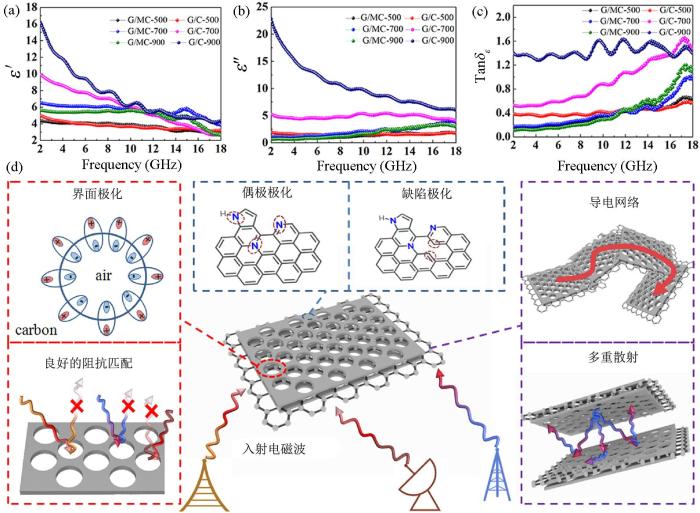
除了构造三维网络体系,多孔结构的引入也能够有效改善阻抗匹配问题,提高石墨烯材料的电磁波衰减能力,是一种拓宽有效吸收带宽的方法[85].因此,由石墨烯与多孔碳组成的复合材料有着巨大的发展前景.Mai et al[86]合成了三明治状的石墨烯@多介孔氮掺杂碳纳米(G/MC)材料.独特的介孔结构不仅使复合材料有着良好的阻抗匹配,而且增加了电磁波散射的路径,有利于电磁波的衰减.在5 wt%的低填充下,复合材料的最小反射损耗和有效带宽分别为-66.1 dB与8.2 GHz(图5). ...
... Simplified illustration for the synthetic procedures of NRGO/MWCNT composite foams (after ref.[
84])
Fig.4![]()
除了构造三维网络体系,多孔结构的引入也能够有效改善阻抗匹配问题,提高石墨烯材料的电磁波衰减能力,是一种拓宽有效吸收带宽的方法[85].因此,由石墨烯与多孔碳组成的复合材料有着巨大的发展前景.Mai et al[86]合成了三明治状的石墨烯@多介孔氮掺杂碳纳米(G/MC)材料.独特的介孔结构不仅使复合材料有着良好的阻抗匹配,而且增加了电磁波散射的路径,有利于电磁波的衰减.在5 wt%的低填充下,复合材料的最小反射损耗和有效带宽分别为-66.1 dB与8.2 GHz(图5). ...
Facile synthesis of N,S?codoped honeycomb?like C/Ni3S2 composites for broadband microwave absorption with low filler mass loading
1
2020
... 除了构造三维网络体系,多孔结构的引入也能够有效改善阻抗匹配问题,提高石墨烯材料的电磁波衰减能力,是一种拓宽有效吸收带宽的方法[85].因此,由石墨烯与多孔碳组成的复合材料有着巨大的发展前景.Mai et al[86]合成了三明治状的石墨烯@多介孔氮掺杂碳纳米(G/MC)材料.独特的介孔结构不仅使复合材料有着良好的阻抗匹配,而且增加了电磁波散射的路径,有利于电磁波的衰减.在5 wt%的低填充下,复合材料的最小反射损耗和有效带宽分别为-66.1 dB与8.2 GHz(图5). ...
The ordered mesoporous carbon coated graphene as a high?performance broadband microwave absorbent
3
2021
... 除了构造三维网络体系,多孔结构的引入也能够有效改善阻抗匹配问题,提高石墨烯材料的电磁波衰减能力,是一种拓宽有效吸收带宽的方法[85].因此,由石墨烯与多孔碳组成的复合材料有着巨大的发展前景.Mai et al[86]合成了三明治状的石墨烯@多介孔氮掺杂碳纳米(G/MC)材料.独特的介孔结构不仅使复合材料有着良好的阻抗匹配,而且增加了电磁波散射的路径,有利于电磁波的衰减.在5 wt%的低填充下,复合材料的最小反射损耗和有效带宽分别为-66.1 dB与8.2 GHz(图5). ...
... [
86]
The real part (a) and imaginary part of permittivity (b) as well as the dielectric loss tangent (c) of G/C and G/MC,schematic diagram of microwave absorption mechanism of G/MC⁃900 composites (d) (after ref.[<xref ref-type="bibr" rid="R86">86</xref>])Fig.5![]()
石墨烯与碳纳米管的结合,增强了界面极化,但损耗单一的固有缺陷仍未得到有效解决.因此,将具有磁损耗能力的材料与石墨烯复合,是当前研究的热点. ...
... The real part (a) and imaginary part of permittivity (b) as well as the dielectric loss tangent (c) of G/C and G/MC,schematic diagram of microwave absorption mechanism of G/MC⁃900 composites (d) (after ref.[
86])
Fig.5![]()
石墨烯与碳纳米管的结合,增强了界面极化,但损耗单一的固有缺陷仍未得到有效解决.因此,将具有磁损耗能力的材料与石墨烯复合,是当前研究的热点. ...
Synthesis of reduced graphene oxides with magnetic Co nanocrystals coating for electromagnetic absorption properties
2
2020
... 磁性金属是一类良好的吸波材料,具有频带宽、兼容性好等优点,广泛地应用于隐身材料中[87].但是,磁性金属也存在易氧化、密度大和不耐腐蚀等缺点,单一的磁损耗机制也会导致低反射损耗和窄的有效吸收带宽,不利于电磁波的衰减,难以满足目前对吸波材料“薄、轻、宽、强”的要求[88].将磁性金属材料与石墨烯类材料复合,石墨烯的导电损耗机制与磁性金属的磁损耗机制能够相结合,使复合材料能够兼具两类材料的优点,具有良好的阻抗匹配特性与强电磁吸波性能.与单独的石墨烯材料相比,GA@Ni[89],GF@Ni[90],N⁃MGF@Co[91],RGO/Co[87],N⁃RGA/Ni[92]等的吸波性能更加优越. ...
... [87],N⁃RGA/Ni[92]等的吸波性能更加优越. ...
Generation of graphene?based aerogel microspheres for broadband and tunable high?performance microwave absorption by electrospinning?freeze drying process
1
2018
... 磁性金属是一类良好的吸波材料,具有频带宽、兼容性好等优点,广泛地应用于隐身材料中[87].但是,磁性金属也存在易氧化、密度大和不耐腐蚀等缺点,单一的磁损耗机制也会导致低反射损耗和窄的有效吸收带宽,不利于电磁波的衰减,难以满足目前对吸波材料“薄、轻、宽、强”的要求[88].将磁性金属材料与石墨烯类材料复合,石墨烯的导电损耗机制与磁性金属的磁损耗机制能够相结合,使复合材料能够兼具两类材料的优点,具有良好的阻抗匹配特性与强电磁吸波性能.与单独的石墨烯材料相比,GA@Ni[89],GF@Ni[90],N⁃MGF@Co[91],RGO/Co[87],N⁃RGA/Ni[92]等的吸波性能更加优越. ...
Synthesis of magnetic graphene aerogels for microwave absorption by in?situ pyrolysis
1
2019
... 磁性金属是一类良好的吸波材料,具有频带宽、兼容性好等优点,广泛地应用于隐身材料中[87].但是,磁性金属也存在易氧化、密度大和不耐腐蚀等缺点,单一的磁损耗机制也会导致低反射损耗和窄的有效吸收带宽,不利于电磁波的衰减,难以满足目前对吸波材料“薄、轻、宽、强”的要求[88].将磁性金属材料与石墨烯类材料复合,石墨烯的导电损耗机制与磁性金属的磁损耗机制能够相结合,使复合材料能够兼具两类材料的优点,具有良好的阻抗匹配特性与强电磁吸波性能.与单独的石墨烯材料相比,GA@Ni[89],GF@Ni[90],N⁃MGF@Co[91],RGO/Co[87],N⁃RGA/Ni[92]等的吸波性能更加优越. ...
3D nitrogen?doped porous magnetic graphene foam?supported Ni nanocomposites with superior microwave absorption properties
1
2019
... 磁性金属是一类良好的吸波材料,具有频带宽、兼容性好等优点,广泛地应用于隐身材料中[87].但是,磁性金属也存在易氧化、密度大和不耐腐蚀等缺点,单一的磁损耗机制也会导致低反射损耗和窄的有效吸收带宽,不利于电磁波的衰减,难以满足目前对吸波材料“薄、轻、宽、强”的要求[88].将磁性金属材料与石墨烯类材料复合,石墨烯的导电损耗机制与磁性金属的磁损耗机制能够相结合,使复合材料能够兼具两类材料的优点,具有良好的阻抗匹配特性与强电磁吸波性能.与单独的石墨烯材料相比,GA@Ni[89],GF@Ni[90],N⁃MGF@Co[91],RGO/Co[87],N⁃RGA/Ni[92]等的吸波性能更加优越. ...
In situ deposition of α?Co nanoparticles on three?dimensional nitrogen?doped porous graphene foams as microwave absorbers
1
2019
... 磁性金属是一类良好的吸波材料,具有频带宽、兼容性好等优点,广泛地应用于隐身材料中[87].但是,磁性金属也存在易氧化、密度大和不耐腐蚀等缺点,单一的磁损耗机制也会导致低反射损耗和窄的有效吸收带宽,不利于电磁波的衰减,难以满足目前对吸波材料“薄、轻、宽、强”的要求[88].将磁性金属材料与石墨烯类材料复合,石墨烯的导电损耗机制与磁性金属的磁损耗机制能够相结合,使复合材料能够兼具两类材料的优点,具有良好的阻抗匹配特性与强电磁吸波性能.与单独的石墨烯材料相比,GA@Ni[89],GF@Ni[90],N⁃MGF@Co[91],RGO/Co[87],N⁃RGA/Ni[92]等的吸波性能更加优越. ...
Three?dimensional nitrogen?doped reduced graphene oxide aerogel decorated with Ni nanoparticles with tunable and unique microwave absorption
1
2019
... 磁性金属是一类良好的吸波材料,具有频带宽、兼容性好等优点,广泛地应用于隐身材料中[87].但是,磁性金属也存在易氧化、密度大和不耐腐蚀等缺点,单一的磁损耗机制也会导致低反射损耗和窄的有效吸收带宽,不利于电磁波的衰减,难以满足目前对吸波材料“薄、轻、宽、强”的要求[88].将磁性金属材料与石墨烯类材料复合,石墨烯的导电损耗机制与磁性金属的磁损耗机制能够相结合,使复合材料能够兼具两类材料的优点,具有良好的阻抗匹配特性与强电磁吸波性能.与单独的石墨烯材料相比,GA@Ni[89],GF@Ni[90],N⁃MGF@Co[91],RGO/Co[87],N⁃RGA/Ni[92]等的吸波性能更加优越. ...
FeNi nanoparticles embedded reduced graphene/nitrogen?doped carbon composites towards the ultra?wideband electro?magnetic wave absorption
3
2021
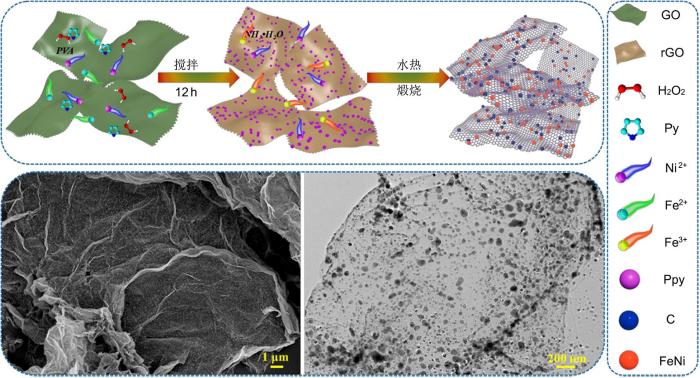
... Wu et al[93]通过调节氧化石墨烯的含量,采用一锅法得到了一系列具有不同复介电常数和阻抗匹配条件的氮掺杂、FeNi纳米颗粒均匀分布的RGO薄片材料RGO/N⁃C/FeNi(图6).这种独特、新颖的结构给石墨烯带来了多重反射和散射、界面极化和偶极极化等的协同作用,使RGO/N⁃C/FeNi复合材料有着优异的吸波性能.通过FeNi/N⁃C,FeNi/rGO和rGO/N⁃C的分级界面提供了界面极化和界面弛豫,这些界面积累了类似电容器结构的电荷,有助于增强吸波材料的介电损耗.5.44 GHz时,厚度为2.5 mm的RGO/N⁃C/FeNi⁃3材料最小反射损耗为-68.89 dB,有效带宽为5.44 GHz. ...
... [
93]
The preparation procedure of RGO/N⁃C/FeNi hybrids,SEM image and TEM image of as⁃synthesized RGO/N⁃C/FeNi hybrid (after ref.[<xref ref-type="bibr" rid="R93">93</xref>])Fig.6![]()
Zhao et al[94]通过原位溶剂热和碳化工程制备了CoNi/RGO气凝胶吸波材料.该材料有着超低密度(7 mg·cm-3)、高比表面积和高度分层多孔的结构.Co,Ni磁损耗与石墨烯的介电损耗的协同作用,使气凝胶有着优异的吸波性能,7 wt%填充率、厚度为0.8 mm的气凝胶材料,最小反射损耗与有效带宽分别为-53.3 dB和4.35 GHz.Kim et al[95]采用化学镀的方法制备了FeCoNi@石墨烯材料.低温的制备方式不仅有助于石墨烯的均匀分散,而且保留了FeCoNi的高磁性,从而增加了损耗能力,改善了阻抗匹配.厚度为2.3 mm的复合材料最小反射损耗可达-68 dB. ...
... The preparation procedure of RGO/N⁃C/FeNi hybrids,SEM image and TEM image of as⁃synthesized RGO/N⁃C/FeNi hybrid (after ref.[
93])
Fig.6![]()
Zhao et al[94]通过原位溶剂热和碳化工程制备了CoNi/RGO气凝胶吸波材料.该材料有着超低密度(7 mg·cm-3)、高比表面积和高度分层多孔的结构.Co,Ni磁损耗与石墨烯的介电损耗的协同作用,使气凝胶有着优异的吸波性能,7 wt%填充率、厚度为0.8 mm的气凝胶材料,最小反射损耗与有效带宽分别为-53.3 dB和4.35 GHz.Kim et al[95]采用化学镀的方法制备了FeCoNi@石墨烯材料.低温的制备方式不仅有助于石墨烯的均匀分散,而且保留了FeCoNi的高磁性,从而增加了损耗能力,改善了阻抗匹配.厚度为2.3 mm的复合材料最小反射损耗可达-68 dB. ...
Ultralight CoNi/rGO aerogels toward excellent microwave absorption at ultrathin thickness
1
2019
... Zhao et al[94]通过原位溶剂热和碳化工程制备了CoNi/RGO气凝胶吸波材料.该材料有着超低密度(7 mg·cm-3)、高比表面积和高度分层多孔的结构.Co,Ni磁损耗与石墨烯的介电损耗的协同作用,使气凝胶有着优异的吸波性能,7 wt%填充率、厚度为0.8 mm的气凝胶材料,最小反射损耗与有效带宽分别为-53.3 dB和4.35 GHz.Kim et al[95]采用化学镀的方法制备了FeCoNi@石墨烯材料.低温的制备方式不仅有助于石墨烯的均匀分散,而且保留了FeCoNi的高磁性,从而增加了损耗能力,改善了阻抗匹配.厚度为2.3 mm的复合材料最小反射损耗可达-68 dB. ...
Magnetic and dispersible FeCoNi?graphene film produced without heat treatment for electromagnetic wave absorption
1
2019
... Zhao et al[94]通过原位溶剂热和碳化工程制备了CoNi/RGO气凝胶吸波材料.该材料有着超低密度(7 mg·cm-3)、高比表面积和高度分层多孔的结构.Co,Ni磁损耗与石墨烯的介电损耗的协同作用,使气凝胶有着优异的吸波性能,7 wt%填充率、厚度为0.8 mm的气凝胶材料,最小反射损耗与有效带宽分别为-53.3 dB和4.35 GHz.Kim et al[95]采用化学镀的方法制备了FeCoNi@石墨烯材料.低温的制备方式不仅有助于石墨烯的均匀分散,而且保留了FeCoNi的高磁性,从而增加了损耗能力,改善了阻抗匹配.厚度为2.3 mm的复合材料最小反射损耗可达-68 dB. ...
Graphene–carbonyl iron cross?linked composites with excellent electro?magnetic wave absorption properties
1
2014
... Zhu et al[96]通过湿化学法制备了还原氧化石墨烯/球形羰基铁复合材料RGO/CIP,厚度为 ...
Digital light processing 3D printing of graphene/carbonyl iron/polymethyl methacrylate nanocomposites for efficient microwave absorption
1
... 3 mm的复合材料最大反射损耗为-52.46 dB,有效带宽为4.19(7.79~11.98) GHz.随后,Yao et al[97]采用数字光处理3D打印技术,制备了轻质石墨烯/CIP/PMMA复合材料.厚度为2.1 mm的复合材料最大反射损耗为-54.4 dB,有效带宽为2.07 GHz.与球形CIP相比,片层状CIP具有更高的磁导率和更适合的介电常数,从而使片状CIP/RGO复合材料表现出更优异的吸波能力. ...
Covalently bonded Fe3O4@SiO2?reduced graphene oxide nanocomposites as high?efficiency electromagnetic wave absorbers
1
2020
... 铁氧体是最早使用的一类电磁损耗材料.铁氧体吸波材料有着吸收性能优异、价格便宜等优点,但高密度、吸收带窄等缺点限制了其进一步的发展.将铁氧体材料与石墨烯类复合,能够增加复合材料的损耗机制,扩大吸收带宽,实现电磁波的高效吸收[98-100].与单一组分相比,Co0.8Fe2.2O4/RGO[101],Co0.33Ni0.33Mn0.33Fe2O4/GN[102],MnFe2O4/RGO[103],ZnFe2O4/RGO[104]和CoFe2O4/RGO[105]的吸波性能有着显著的提高. ...
Preparation of pod?like 3D Ni0.33Co0.67Fe2O4@rGO composites and their microwave absorbing properties
0
2019
One?step hydrothermal synthesis and enhanced microwave absorption properties of Ni0.5Co0.5Fe2O4/graphene composites in low frequency band
1
2018
... 铁氧体是最早使用的一类电磁损耗材料.铁氧体吸波材料有着吸收性能优异、价格便宜等优点,但高密度、吸收带窄等缺点限制了其进一步的发展.将铁氧体材料与石墨烯类复合,能够增加复合材料的损耗机制,扩大吸收带宽,实现电磁波的高效吸收[98-100].与单一组分相比,Co0.8Fe2.2O4/RGO[101],Co0.33Ni0.33Mn0.33Fe2O4/GN[102],MnFe2O4/RGO[103],ZnFe2O4/RGO[104]和CoFe2O4/RGO[105]的吸波性能有着显著的提高. ...
Synthesis of nonstoichiometric Co0.8Fe2.2O4/reduced graphene oxide (rGO) nanocomposites and their excellent electromagnetic wave absorption property
1
2019
... 铁氧体是最早使用的一类电磁损耗材料.铁氧体吸波材料有着吸收性能优异、价格便宜等优点,但高密度、吸收带窄等缺点限制了其进一步的发展.将铁氧体材料与石墨烯类复合,能够增加复合材料的损耗机制,扩大吸收带宽,实现电磁波的高效吸收[98-100].与单一组分相比,Co0.8Fe2.2O4/RGO[101],Co0.33Ni0.33Mn0.33Fe2O4/GN[102],MnFe2O4/RGO[103],ZnFe2O4/RGO[104]和CoFe2O4/RGO[105]的吸波性能有着显著的提高. ...
Achieving ultra?high electromagnetic wave absorption by anchoring Co0.33Ni0.33Mn0.33Fe2O4 nanoparticles on graphene sheets using microwave?assisted polyol method
1
2018
... 铁氧体是最早使用的一类电磁损耗材料.铁氧体吸波材料有着吸收性能优异、价格便宜等优点,但高密度、吸收带窄等缺点限制了其进一步的发展.将铁氧体材料与石墨烯类复合,能够增加复合材料的损耗机制,扩大吸收带宽,实现电磁波的高效吸收[98-100].与单一组分相比,Co0.8Fe2.2O4/RGO[101],Co0.33Ni0.33Mn0.33Fe2O4/GN[102],MnFe2O4/RGO[103],ZnFe2O4/RGO[104]和CoFe2O4/RGO[105]的吸波性能有着显著的提高. ...
Cubic MnFe2O4 particles decorated reduced graphene oxide with excellent microwave absorption properties
1
2018
... 铁氧体是最早使用的一类电磁损耗材料.铁氧体吸波材料有着吸收性能优异、价格便宜等优点,但高密度、吸收带窄等缺点限制了其进一步的发展.将铁氧体材料与石墨烯类复合,能够增加复合材料的损耗机制,扩大吸收带宽,实现电磁波的高效吸收[98-100].与单一组分相比,Co0.8Fe2.2O4/RGO[101],Co0.33Ni0.33Mn0.33Fe2O4/GN[102],MnFe2O4/RGO[103],ZnFe2O4/RGO[104]和CoFe2O4/RGO[105]的吸波性能有着显著的提高. ...
Synthesis and high?performance microwave absorption of reduced graphene oxide/zinc ferrite hybrid nanocomposite
1
2018
... 铁氧体是最早使用的一类电磁损耗材料.铁氧体吸波材料有着吸收性能优异、价格便宜等优点,但高密度、吸收带窄等缺点限制了其进一步的发展.将铁氧体材料与石墨烯类复合,能够增加复合材料的损耗机制,扩大吸收带宽,实现电磁波的高效吸收[98-100].与单一组分相比,Co0.8Fe2.2O4/RGO[101],Co0.33Ni0.33Mn0.33Fe2O4/GN[102],MnFe2O4/RGO[103],ZnFe2O4/RGO[104]和CoFe2O4/RGO[105]的吸波性能有着显著的提高. ...
Broadband and lightweight microwave absorber constructed by in situ growth of hierarchical CoFe2O4/reduced graphene oxide porous nanocomposites
1
2018
... 铁氧体是最早使用的一类电磁损耗材料.铁氧体吸波材料有着吸收性能优异、价格便宜等优点,但高密度、吸收带窄等缺点限制了其进一步的发展.将铁氧体材料与石墨烯类复合,能够增加复合材料的损耗机制,扩大吸收带宽,实现电磁波的高效吸收[98-100].与单一组分相比,Co0.8Fe2.2O4/RGO[101],Co0.33Ni0.33Mn0.33Fe2O4/GN[102],MnFe2O4/RGO[103],ZnFe2O4/RGO[104]和CoFe2O4/RGO[105]的吸波性能有着显著的提高. ...
Synthesis of covalently bonded reduced graphene oxide?Fe3O4 nanocomposites for efficient electromagnetic wave absorption
3
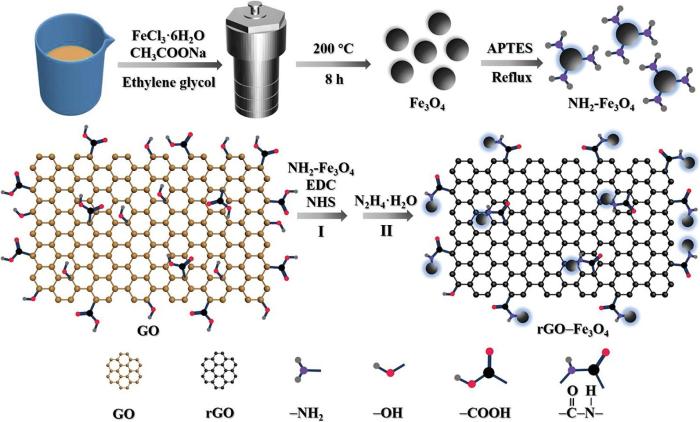
2021
... Huang et al[106]通过水热、酰胺化和还原反应,合成了共价键合的RGO⁃Fe3O4复合材料(图7).复合材料不仅有效利用了介质损耗和磁损耗的协同作用,而且通过引入共价键,促进电子迁移,显著提高了材料的吸波性能.共价键是复合材料中稳定的载流子通道,促进了电子在不同组分之间迁移,从而提高电磁波的吸收性能.匹配厚度为2.1 mm时,复合材料的最小反射损耗与有效带宽分别为-48.6 dB和6.32 GHz. ...
... [
106]
Schematic diagram of the preparation process of RGO⁃Fe<sub>3</sub>O<sub>4</sub> nanocomposites (after ref.[<xref ref-type="bibr" rid="R106">106</xref>])Fig.7![]()
Shu et al[107]通过水热法制备了氮掺杂还原氧化石墨烯/镍铁氧体(NRGO/NiFe2O4)复合材料.其中,水合肼的添加量与填料载量对NRGO/NiFe2O4复合材料的吸波性能有显著影响.随着填料的增加,NRGO/NiFe2O4复合材料的衰减系数α也随之增加,但高含量的填料不利于阻抗匹配,50 wt%填充负载下,NRGO/NiFe2O4复合材料的更接近1,因而具有最佳的电磁吸波性能.厚度为2.2 mm的NRGO/NiFe2O4复合材料,最小反射损耗与有效带宽分别为-54.4 dB和4.5 GHz.Ding et al[108]通过水热法制备CuFe2O4/RGO复合材料.RGO与CuFe2O4之间存在的大量非均匀界面显著增强了界面极化,RGO中残留官能团、结构缺陷也会产生缺陷极化和偶极极化,CuFe2O4在交变磁场中也会发生涡流损耗等磁损耗,这些因素使得复合材料有着较高的反射损耗和阻抗匹配特性.在匹配频率为9.2 GHz、匹配厚度为2.56 mm的条件下,RGO添加量为20 mg的CuFe2O4/RGO⁃20材料有最小的反射损耗-58.7 dB,并且此时近似1,CuFe2O4/RGO⁃20有着最佳的阻抗匹配条件. ...
... nanocomposites (after ref.[
106])
Fig.7![]()
Shu et al[107]通过水热法制备了氮掺杂还原氧化石墨烯/镍铁氧体(NRGO/NiFe2O4)复合材料.其中,水合肼的添加量与填料载量对NRGO/NiFe2O4复合材料的吸波性能有显著影响.随着填料的增加,NRGO/NiFe2O4复合材料的衰减系数α也随之增加,但高含量的填料不利于阻抗匹配,50 wt%填充负载下,NRGO/NiFe2O4复合材料的更接近1,因而具有最佳的电磁吸波性能.厚度为2.2 mm的NRGO/NiFe2O4复合材料,最小反射损耗与有效带宽分别为-54.4 dB和4.5 GHz.Ding et al[108]通过水热法制备CuFe2O4/RGO复合材料.RGO与CuFe2O4之间存在的大量非均匀界面显著增强了界面极化,RGO中残留官能团、结构缺陷也会产生缺陷极化和偶极极化,CuFe2O4在交变磁场中也会发生涡流损耗等磁损耗,这些因素使得复合材料有着较高的反射损耗和阻抗匹配特性.在匹配频率为9.2 GHz、匹配厚度为2.56 mm的条件下,RGO添加量为20 mg的CuFe2O4/RGO⁃20材料有最小的反射损耗-58.7 dB,并且此时近似1,CuFe2O4/RGO⁃20有着最佳的阻抗匹配条件. ...
Facile synthesis of nitrogen?doped reduced graphene oxide/nickel ferrite hybrid nanocomposites with superior electromagnetic wave absorption performance in the X?band
1
2021
... Shu et al[107]通过水热法制备了氮掺杂还原氧化石墨烯/镍铁氧体(NRGO/NiFe2O4)复合材料.其中,水合肼的添加量与填料载量对NRGO/NiFe2O4复合材料的吸波性能有显著影响.随着填料的增加,NRGO/NiFe2O4复合材料的衰减系数α也随之增加,但高含量的填料不利于阻抗匹配,50 wt%填充负载下,NRGO/NiFe2O4复合材料的更接近1,因而具有最佳的电磁吸波性能.厚度为2.2 mm的NRGO/NiFe2O4复合材料,最小反射损耗与有效带宽分别为-54.4 dB和4.5 GHz.Ding et al[108]通过水热法制备CuFe2O4/RGO复合材料.RGO与CuFe2O4之间存在的大量非均匀界面显著增强了界面极化,RGO中残留官能团、结构缺陷也会产生缺陷极化和偶极极化,CuFe2O4在交变磁场中也会发生涡流损耗等磁损耗,这些因素使得复合材料有着较高的反射损耗和阻抗匹配特性.在匹配频率为9.2 GHz、匹配厚度为2.56 mm的条件下,RGO添加量为20 mg的CuFe2O4/RGO⁃20材料有最小的反射损耗-58.7 dB,并且此时近似1,CuFe2O4/RGO⁃20有着最佳的阻抗匹配条件. ...
Structural characterization and microwave absorbing performance of CuFe2O4/RGO composites
1
... Shu et al[107]通过水热法制备了氮掺杂还原氧化石墨烯/镍铁氧体(NRGO/NiFe2O4)复合材料.其中,水合肼的添加量与填料载量对NRGO/NiFe2O4复合材料的吸波性能有显著影响.随着填料的增加,NRGO/NiFe2O4复合材料的衰减系数α也随之增加,但高含量的填料不利于阻抗匹配,50 wt%填充负载下,NRGO/NiFe2O4复合材料的更接近1,因而具有最佳的电磁吸波性能.厚度为2.2 mm的NRGO/NiFe2O4复合材料,最小反射损耗与有效带宽分别为-54.4 dB和4.5 GHz.Ding et al[108]通过水热法制备CuFe2O4/RGO复合材料.RGO与CuFe2O4之间存在的大量非均匀界面显著增强了界面极化,RGO中残留官能团、结构缺陷也会产生缺陷极化和偶极极化,CuFe2O4在交变磁场中也会发生涡流损耗等磁损耗,这些因素使得复合材料有着较高的反射损耗和阻抗匹配特性.在匹配频率为9.2 GHz、匹配厚度为2.56 mm的条件下,RGO添加量为20 mg的CuFe2O4/RGO⁃20材料有最小的反射损耗-58.7 dB,并且此时近似1,CuFe2O4/RGO⁃20有着最佳的阻抗匹配条件. ...
Rational construction of porous N?doped Fe2O3 films on porous graphene foams by molecular layer deposition for tunable microwave absorption
3
2021
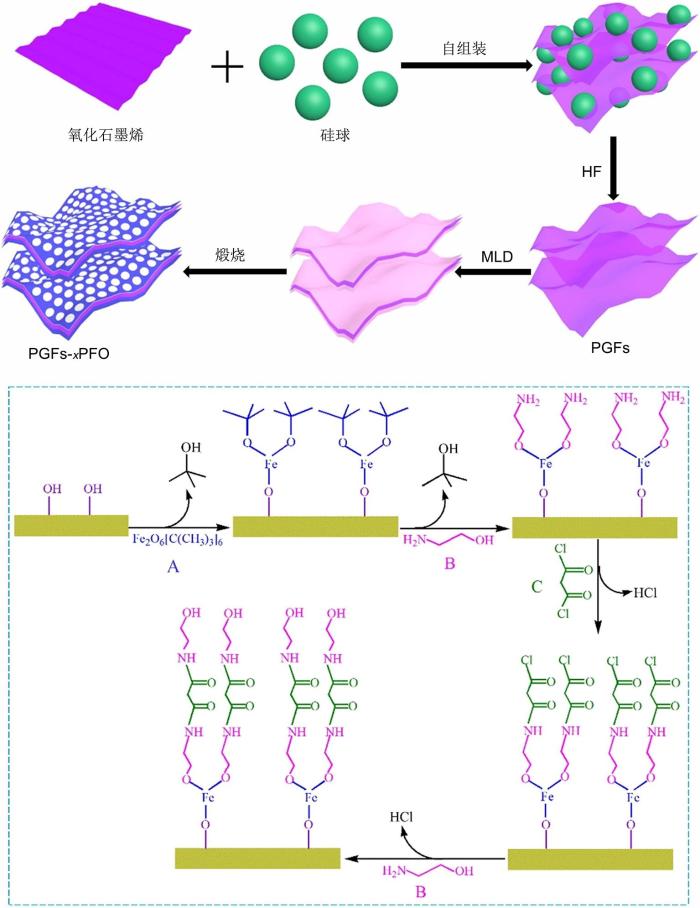
... Zhao et al[109]利用分子层沉积,将孔隙结构均匀的Fe2O3沉积在多孔石墨烯泡沫上,制备了PGFs⁃xPFO复合材料(图8).分子层沉积技术将PGFs和PFO膜紧密结合,改善了界面处的电荷积累与转移.与原始的石墨烯泡沫相比,厚度为2.18 mm的PGFs⁃xPFO复合材料的最小反射损耗提高了八倍,达到-64.36 dB. ...
... [
109]
Schematic illustration of the synthesis procedures of PGFs⁃<i>x</i>PFO and the growth of Fe⁃hybrid film via four⁃step ABCB reaction sequence using tert⁃butoxide (Fe<sub>2</sub>(<sup>t</sup>BuO)<sub>6</sub>,precursor A),ethanolamine (EA,precursor B), malonyl chloride (MC,precursor C) and ethanolamine (EA,precursor B) as precursors (after ref.[<xref ref-type="bibr" rid="R109">109</xref>])Fig.8![]()
此外,通过构建分层纳米结构也能够使得石墨烯/铁氧体材料获得优异的吸波性能[110-111].Meng et al[112]通过聚多巴胺黏合、乙二醇介导的方法,在石墨烯的两侧生长了四氧化三铁纳米片.在Fe3O4纳米阵列生长的同时,也对氧化石墨烯进行了还原.这种独特的3D构型和生成机制使得复合材料表现出优良的吸波性能,厚度为2.7 mm的复合材料最大反射损耗为-52.8 dB. ...
... ,precursor A),ethanolamine (EA,precursor B), malonyl chloride (MC,precursor C) and ethanolamine (EA,precursor B) as precursors (after ref.[
109])
Fig.8![]()
此外,通过构建分层纳米结构也能够使得石墨烯/铁氧体材料获得优异的吸波性能[110-111].Meng et al[112]通过聚多巴胺黏合、乙二醇介导的方法,在石墨烯的两侧生长了四氧化三铁纳米片.在Fe3O4纳米阵列生长的同时,也对氧化石墨烯进行了还原.这种独特的3D构型和生成机制使得复合材料表现出优良的吸波性能,厚度为2.7 mm的复合材料最大反射损耗为-52.8 dB. ...
Enhanced microwave absorption performances of polyaniline/graphene aerogel by covalent bonding
1
2019
... 此外,通过构建分层纳米结构也能够使得石墨烯/铁氧体材料获得优异的吸波性能[110-111].Meng et al[112]通过聚多巴胺黏合、乙二醇介导的方法,在石墨烯的两侧生长了四氧化三铁纳米片.在Fe3O4纳米阵列生长的同时,也对氧化石墨烯进行了还原.这种独特的3D构型和生成机制使得复合材料表现出优良的吸波性能,厚度为2.7 mm的复合材料最大反射损耗为-52.8 dB. ...
Improvement of thermal stability and gamma?ray absorption in microwave absorbable poly(methyl methacrylate)/graphene nanoplatelets nanocomposite
1
2021
... 此外,通过构建分层纳米结构也能够使得石墨烯/铁氧体材料获得优异的吸波性能[110-111].Meng et al[112]通过聚多巴胺黏合、乙二醇介导的方法,在石墨烯的两侧生长了四氧化三铁纳米片.在Fe3O4纳米阵列生长的同时,也对氧化石墨烯进行了还原.这种独特的3D构型和生成机制使得复合材料表现出优良的吸波性能,厚度为2.7 mm的复合材料最大反射损耗为-52.8 dB. ...
Morphology?controlled synthesis and novel microwave absorption properties of hollow urchinlike α?MnO2 nano?structures
1
2010
... 此外,通过构建分层纳米结构也能够使得石墨烯/铁氧体材料获得优异的吸波性能[110-111].Meng et al[112]通过聚多巴胺黏合、乙二醇介导的方法,在石墨烯的两侧生长了四氧化三铁纳米片.在Fe3O4纳米阵列生长的同时,也对氧化石墨烯进行了还原.这种独特的3D构型和生成机制使得复合材料表现出优良的吸波性能,厚度为2.7 mm的复合材料最大反射损耗为-52.8 dB. ...
Growth of γ?Fe2O3 nanosheet arrays on graphene for electromagnetic absorption applications
1
2014
... 聚合物作为基质提供了出色的热稳定性、良好的氧化和腐蚀性保护以及优异的工程性能.石墨烯/聚合物材料具有密度低、比表面积大、屏障效应好和抗渗透等优点,在电磁吸波材料领域有广泛应用[113-115].Wang et al[116]通过原位聚合法制备了石墨烯@樟脑磺酸掺杂聚苯胺(GO@CSA⁃PANi)纳米复合材料.界面极化、缺陷弛豫和特殊的手性结构,增强了材料的极化损耗,实现了材料与自由空间的阻抗匹配.GO@CSA⁃PANi纳米复合材料在匹配厚度为2.4 mm时,具有-48.1 dB的强反射损耗和5.3 GHz的有效带宽. ...
Growth of Fe3O4 nanosheet arrays on graphene by a mussel?inspired polydopamine adhesive for remarkable enhancement in electromagnetic absorptions
0
2015
Microwave absorption performance enhancement using glass fiber?reinforced polymer nanocomposites containing dielectric fillers in X?band
1
2020
... 聚合物作为基质提供了出色的热稳定性、良好的氧化和腐蚀性保护以及优异的工程性能.石墨烯/聚合物材料具有密度低、比表面积大、屏障效应好和抗渗透等优点,在电磁吸波材料领域有广泛应用[113-115].Wang et al[116]通过原位聚合法制备了石墨烯@樟脑磺酸掺杂聚苯胺(GO@CSA⁃PANi)纳米复合材料.界面极化、缺陷弛豫和特殊的手性结构,增强了材料的极化损耗,实现了材料与自由空间的阻抗匹配.GO@CSA⁃PANi纳米复合材料在匹配厚度为2.4 mm时,具有-48.1 dB的强反射损耗和5.3 GHz的有效带宽. ...
Two birds with one stone:Graphene oxide@sulfonated polyaniline nanocomposites towards high?performance electro?magnetic wave absorption and corrosion protection
1
... 聚合物作为基质提供了出色的热稳定性、良好的氧化和腐蚀性保护以及优异的工程性能.石墨烯/聚合物材料具有密度低、比表面积大、屏障效应好和抗渗透等优点,在电磁吸波材料领域有广泛应用[113-115].Wang et al[116]通过原位聚合法制备了石墨烯@樟脑磺酸掺杂聚苯胺(GO@CSA⁃PANi)纳米复合材料.界面极化、缺陷弛豫和特殊的手性结构,增强了材料的极化损耗,实现了材料与自由空间的阻抗匹配.GO@CSA⁃PANi纳米复合材料在匹配厚度为2.4 mm时,具有-48.1 dB的强反射损耗和5.3 GHz的有效带宽. ...
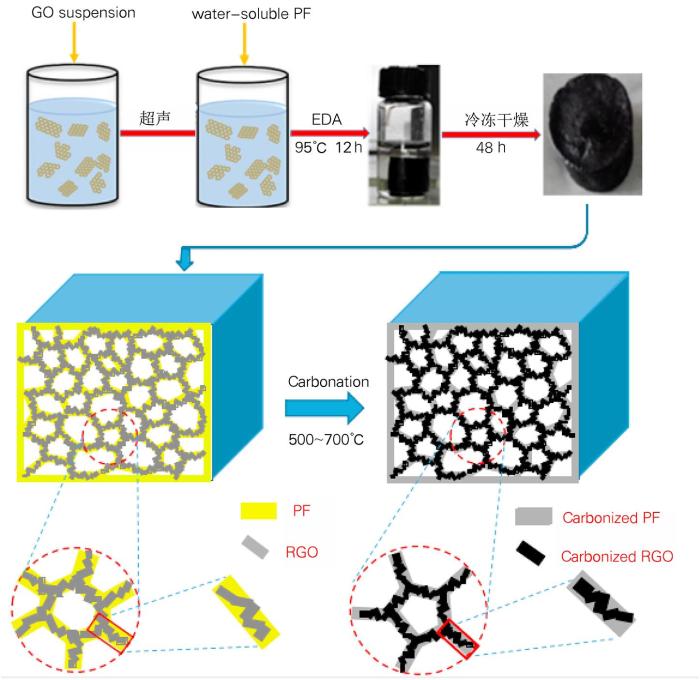
Carbonized foams from graphene/phenolic resin composite aerogels for superior electromagnetic wave absorbers
3
2021
... Li et al[117]以氧化石墨烯与水溶性酚醛树脂为原料,通过化学还原和自组装等步骤制备了一系列三维石墨烯/酚醛树脂复合气凝胶(图9).酚醛树脂与氧化石墨烯之间的强亲和性有效避免了化学还原过程中还原氧化石墨烯的再堆积.通过调节石墨烯的添加量和碳化温度可以改变复合材料气凝胶的介电常数,实现阻抗匹配的电磁损耗的良好平衡.实验结果表明,厚度为2 mm的气凝胶材料,最小反射损耗与有效带宽分别为-22.7 dB和5.4 GHz.此外,轻质(24.3 mg·cm-3)、耐高温和耐腐蚀的性质,使其为制备多功能的超轻材料提供了新的途径. ...
... [
117]
Graphical fabrication process of GPFs and GPFs(T) (after ref.[<xref ref-type="bibr" rid="R117">117</xref>])Fig.9![]()
Pu et al[118]以聚酰亚胺为三维多孔骨架,通过两步真空浸渍,构建了具有多级阻抗梯度结构的聚酰亚胺/石墨烯复合泡沫(PI⁃GP⁃RGO).通过控制骨架的阻抗梯度能够有效调节材料的吸波性能,优化后的PI⁃GP⁃RGO在4.0 mm 厚度时,最小反射损耗与有效带宽分别为-32.87 dB和6.22 GHz. ...
... Graphical fabrication process of GPFs and GPFs(T) (after ref.[
117])
Fig.9![]()
Pu et al[118]以聚酰亚胺为三维多孔骨架,通过两步真空浸渍,构建了具有多级阻抗梯度结构的聚酰亚胺/石墨烯复合泡沫(PI⁃GP⁃RGO).通过控制骨架的阻抗梯度能够有效调节材料的吸波性能,优化后的PI⁃GP⁃RGO在4.0 mm 厚度时,最小反射损耗与有效带宽分别为-32.87 dB和6.22 GHz. ...
Polyimide?based graphene composite foams with hierarchical impedance gradient for efficient electromagnetic absorption
1
2021
... Pu et al[118]以聚酰亚胺为三维多孔骨架,通过两步真空浸渍,构建了具有多级阻抗梯度结构的聚酰亚胺/石墨烯复合泡沫(PI⁃GP⁃RGO).通过控制骨架的阻抗梯度能够有效调节材料的吸波性能,优化后的PI⁃GP⁃RGO在4.0 mm 厚度时,最小反射损耗与有效带宽分别为-32.87 dB和6.22 GHz. ...
A competitive reaction strategy toward binary metal sulfides for tailoring electromagnetic wave absorption
1
... 单组分材料难以实现界面阻抗匹配和强电磁吸收的完美结合,而对多元组分复合材料进行合理地调控能够赋予复合材料合适的阻抗匹配和强吸波能力[119-120]. ...
Enhancing the low/middle?frequency electromagnetic wave absorption of metal sulfides through F- regulation engineering
1
... 单组分材料难以实现界面阻抗匹配和强电磁吸收的完美结合,而对多元组分复合材料进行合理地调控能够赋予复合材料合适的阻抗匹配和强吸波能力[119-120]. ...
Rational design of 2D hierarchically laminated Fe3O4@nanoporous?carbon@rGO nanocomposites with strong magnetic coupling for excellent electromagnetic absorption applications
1
2020
... 引入第二损耗成分如铁氧体、聚合物等构建二元复合材料能够解决石墨烯材料阻抗不匹配的问题,在此基础上,设计石墨烯基多元复合材料以实现多组分界面极化与高阻抗匹配成为了当前研究的热点[121-123]. ...
CoNi nanoparticles encapsulated by nitrogen?doped carbon nanotube arrays on reduced graphene oxide sheets for electromagnetic wave absorption
0
N?doped reduced graphene oxide aerogels containing pod?like N?doped carbon nanotubes and FeNi nanoparticles for electromagnetic wave absorption
1
2020
... 引入第二损耗成分如铁氧体、聚合物等构建二元复合材料能够解决石墨烯材料阻抗不匹配的问题,在此基础上,设计石墨烯基多元复合材料以实现多组分界面极化与高阻抗匹配成为了当前研究的热点[121-123]. ...
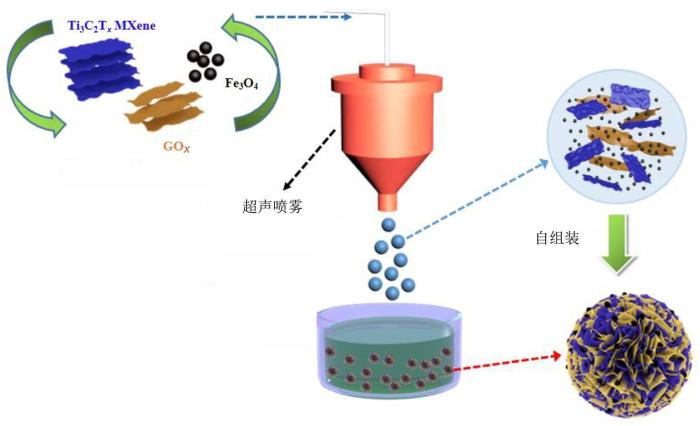
Preparation of pleated RGO/MXene/Fe3O4 microsphere and its absorption properties for electromagnetic wave
3
2021
... Cui et al[124]通过超声喷雾技术将还原氧化石墨烯、MXene和Fe3O4纳米粒子组装成褶皱的RGO/MXene/Fe3O4微球(图10).RGO和MXene相似的二维层状结构有利于不同层的重叠,形成强π⁃π相互作用.这种独特的排列方式使得微球具有与层状材料相似的等距纳米通道.实验结果表明RGO∶MXene∶Fe3O4的质量比为4∶1∶0.8的FMCM⁃3具有最优异的性能,厚度为2.9 mm的微球材料的最小反射损耗和有效吸收带宽分别为-51.2 dB和4.7 GHz. ...
... [
124]
The schematic diagram of preparation process of FMCM (after ref.[<xref ref-type="bibr" rid="R124">124</xref>])Fig.10![]()
Liu et al[125]用Fe3O4、聚(3,4⁃乙二氧噻吩)和RGO制备核壳Fe3O4@PEDOT/RGO复合材料.RGO中的缺陷与残留官能团产生的偶极极化、材料中非均相界面如Fe3O4/聚(3,4⁃乙二氧噻吩)与RGO/聚(3,4⁃乙二氧噻吩)等产生的界面极化、磁性Fe3O4微球产生的磁损耗等机制相互协同,使复合材料具备优异的电磁衰减能力.核壳Fe3O4@PEDOT/RGO复合材料在9.12 GHz处反射损耗为-48.8 dB,有效吸收带宽为4.32 GHz. ...
... The schematic diagram of preparation process of FMCM (after ref.[
124])
Fig.10![]()
Liu et al[125]用Fe3O4、聚(3,4⁃乙二氧噻吩)和RGO制备核壳Fe3O4@PEDOT/RGO复合材料.RGO中的缺陷与残留官能团产生的偶极极化、材料中非均相界面如Fe3O4/聚(3,4⁃乙二氧噻吩)与RGO/聚(3,4⁃乙二氧噻吩)等产生的界面极化、磁性Fe3O4微球产生的磁损耗等机制相互协同,使复合材料具备优异的电磁衰减能力.核壳Fe3O4@PEDOT/RGO复合材料在9.12 GHz处反射损耗为-48.8 dB,有效吸收带宽为4.32 GHz. ...
Enhanced electromagnetic wave absorption performance of core?shell Fe3O4@poly(3,4?ethylenedioxythiophene) microspheres/reduced graphene oxide composite
1
2021
... Liu et al[125]用Fe3O4、聚(3,4⁃乙二氧噻吩)和RGO制备核壳Fe3O4@PEDOT/RGO复合材料.RGO中的缺陷与残留官能团产生的偶极极化、材料中非均相界面如Fe3O4/聚(3,4⁃乙二氧噻吩)与RGO/聚(3,4⁃乙二氧噻吩)等产生的界面极化、磁性Fe3O4微球产生的磁损耗等机制相互协同,使复合材料具备优异的电磁衰减能力.核壳Fe3O4@PEDOT/RGO复合材料在9.12 GHz处反射损耗为-48.8 dB,有效吸收带宽为4.32 GHz. ...
Hybrid metamaterial absorber for ultra?low and dual?broadband absorption
1
2021
... Zhang et al[126]将羰基铁纳米晶片通过聚丙烯酰亚胺泡沫与石墨烯薄膜进行连接制备了杂化超材料吸收体.羰基铁磁性金属的引入使材料有着较高的磁导率,有助于低频下的阻抗匹配,并衰减入射电磁功率.实验模拟表明磁性金属与石墨烯的协同作用.磁性金属和石墨烯相互偶合,使超低频率(<1 GHz)的反射损耗显著提高,同时超材料在1~18 GHz和26.5~40 GHz双频范围有着优异吸收性能. ...
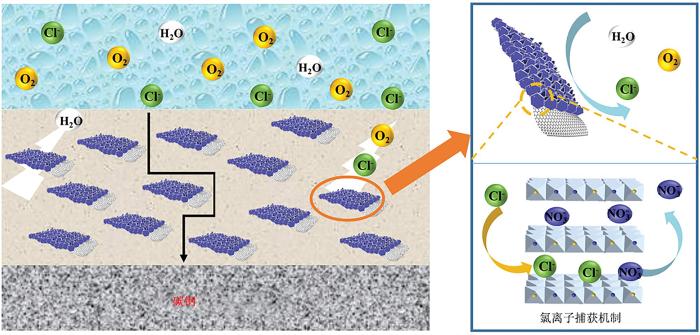
Growth of NiAl?layered double hydroxide on graphene toward excellent anticorrosive microwave absorption application
3
2021
... Xu et al[127]通过原子层沉积法辅助原位生长制备了3D镍铝层状氢氧化物/石墨烯(NiAl⁃LDH/G)复合纳米薄片.低导电性的镍铝层状双氢氧化物的引入可以有效弥补高电导性石墨烯的缺点.通过调节镍铝层状双氢氧化物在复合材料中的含量,可以实现良好的阻抗匹配和高效微波吸收性能.界面极化损耗、传导损耗与三维多孔夹层结构的协同作用使得NiAl⁃LDH/G材料的最小反射损耗与带宽分别为-41.5 dB和4.4 GHz.此外,NiAl⁃LDH的封装效应能够有效抑制石墨烯引起的电偶腐蚀.石墨烯的防渗透性与NiAl⁃LDH的氯离子捕获能力相结合,使其具有了优异的耐腐蚀性能(图11).这一研究推动了满足涂料防腐蚀性能要求的功能性吸波材料的发展. ...
... [
127]
Schematic of the corrosion protection mechanism of NiAl⁃LDH/G (after ref.[<xref ref-type="bibr" rid="R127">127</xref>])Fig.11![]()
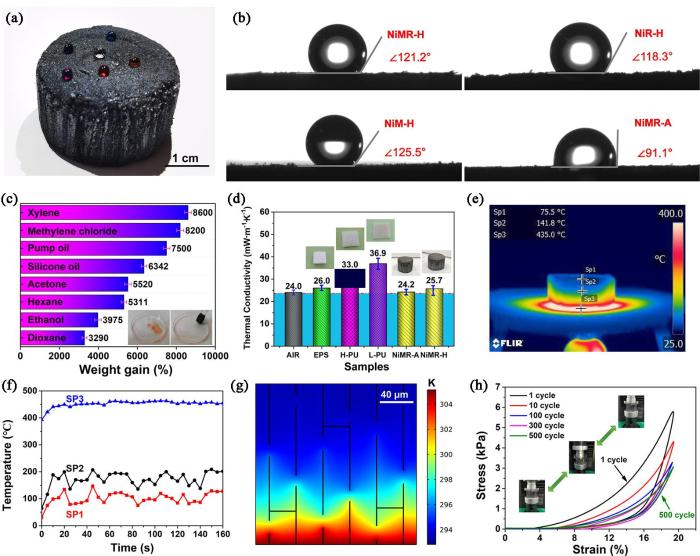
Liang et al[128]通过定向冻结、肼蒸气还原制备了Ni/Ti3C2T x MXene/RGO气凝胶.适量的纳米镍掺杂有效增加了气凝胶的磁损耗能力.温和的肼蒸气还原和规则的多孔结构产生良好的阻抗匹配,使更多的电磁波进入气凝胶内部而不是从表面反射.实验结果表明,在厚度为2.15 mm和0.64 wt%的低填充率下,Ni/Ti3C2T x MXene/RGO气凝胶的最小反射损耗为-75.2 dB,有效带宽为7.3 GHz.除此之外,优异的机械性能、高疏水和隔热性能,使其在高温、潮湿等恶劣环境下有着独特的优势(图12).这为制备多功能吸波材料以适应不同的操作环境提供了新的方向. ...
... Schematic of the corrosion protection mechanism of NiAl⁃LDH/G (after ref.[
127])
Fig.11![]()
Liang et al[128]通过定向冻结、肼蒸气还原制备了Ni/Ti3C2T x MXene/RGO气凝胶.适量的纳米镍掺杂有效增加了气凝胶的磁损耗能力.温和的肼蒸气还原和规则的多孔结构产生良好的阻抗匹配,使更多的电磁波进入气凝胶内部而不是从表面反射.实验结果表明,在厚度为2.15 mm和0.64 wt%的低填充率下,Ni/Ti3C2T x MXene/RGO气凝胶的最小反射损耗为-75.2 dB,有效带宽为7.3 GHz.除此之外,优异的机械性能、高疏水和隔热性能,使其在高温、潮湿等恶劣环境下有着独特的优势(图12).这为制备多功能吸波材料以适应不同的操作环境提供了新的方向. ...
Multifunctional magnetic Ti3C2Tx MXene/graphene aerogel with superior electromagnetic wave absorption performance
3
2021
... Liang et al[128]通过定向冻结、肼蒸气还原制备了Ni/Ti3C2T x MXene/RGO气凝胶.适量的纳米镍掺杂有效增加了气凝胶的磁损耗能力.温和的肼蒸气还原和规则的多孔结构产生良好的阻抗匹配,使更多的电磁波进入气凝胶内部而不是从表面反射.实验结果表明,在厚度为2.15 mm和0.64 wt%的低填充率下,Ni/Ti3C2T x MXene/RGO气凝胶的最小反射损耗为-75.2 dB,有效带宽为7.3 GHz.除此之外,优异的机械性能、高疏水和隔热性能,使其在高温、潮湿等恶劣环境下有着独特的优势(图12).这为制备多功能吸波材料以适应不同的操作环境提供了新的方向. ...
... 【
128】
(a) Digital photo of water droplets standing on a NiMR⁃H aerogel; (b) WCA images of NiMR⁃H,NiR⁃H,NiM⁃H,and NiMR⁃A aerogels; (c) absorption capacities of the NiMR⁃H aerogel for various organic liquids (inset shows the absorption process for hexane dyed by Sudan red Ⅲ); (d) thermal conductivities of EPS,high⁃density/low⁃density PU foams,and NiMR aerogels; (e) infrared thermal image of NiMR⁃H aerogel heating by an alcohol lamp and (f) corresponding temperature⁃time curves of the test points; (g) finite element simulation of the temperature change in the NiMR⁃H aerogel; (h) cyclic compressive stress⁃strain curves of the NiMR⁃H aerogel at 20% strain for 500 cycles (after ref.[<xref ref-type="bibr" rid="R128">128</xref>])Fig.12![]()
由于不同组分之间的协同效应,增强了界面极化,改善了阻抗匹配,石墨烯基多组分复合材料表现出优异的吸波性能.但是,不同组分之间界面相容性差、制备工艺复杂等问题也是不容忽视的,这对实现石墨烯基多组分复合材料的大规模工业化生产仍是巨大的挑战. ...
... (a) Digital photo of water droplets standing on a NiMR⁃H aerogel; (b) WCA images of NiMR⁃H,NiR⁃H,NiM⁃H,and NiMR⁃A aerogels; (c) absorption capacities of the NiMR⁃H aerogel for various organic liquids (inset shows the absorption process for hexane dyed by Sudan red Ⅲ); (d) thermal conductivities of EPS,high⁃density/low⁃density PU foams,and NiMR aerogels; (e) infrared thermal image of NiMR⁃H aerogel heating by an alcohol lamp and (f) corresponding temperature⁃time curves of the test points; (g) finite element simulation of the temperature change in the NiMR⁃H aerogel; (h) cyclic compressive stress⁃strain curves of the NiMR⁃H aerogel at 20% strain for 500 cycles (after ref.[
128])
Fig.12![]()
由于不同组分之间的协同效应,增强了界面极化,改善了阻抗匹配,石墨烯基多组分复合材料表现出优异的吸波性能.但是,不同组分之间界面相容性差、制备工艺复杂等问题也是不容忽视的,这对实现石墨烯基多组分复合材料的大规模工业化生产仍是巨大的挑战. ...